Showing posts with label chemists in the news. Show all posts

Wednesday, June 4, 2025

RIP Robert Holton

Via the Tallahassee Democrat, this sad news: 

Dr. Robert Anthony Holton, known as “Bob” to friends and colleagues, was a groundbreaking chemist and the scientist behind the first total synthesis of the cancer drug Taxol. He died peacefully at his home in Tallahassee, Florida, on May 21, 2025. He was 81.

Born in Fayetteville, North Carolina, and raised in Charlotte, he was the son of Marion Downing Holton and Aaron T. Holton. He met his first wife, Juanita Bird, at the University of North Carolina at Chapel Hill while earning his undergraduate degree in chemistry. They moved to Tallahassee, where he earned his doctorate from Florida State University and had their first son, Robert. After postdoctoral work at Stanford University, where their second son, David, was born, he held faculty positions at Purdue University and Virginia Tech. He returned to FSU in 1986 with his second wife, Dr. Marie E. Krafft, where they both held faculty appointments in the Department of Chemistry & Biochemistry and had their son, Paul. He spent the remainder of his career at FSU.

He is best known for his work on Taxol, a potent chemotherapy agent originally derived from the bark of the Pacific yew tree. The semisynthetic process he developed was the first commercially viable method for large-scale production. In 1993, he and his research group achieved the first successful total synthesis of Taxol, one of the most intricate and celebrated accomplishments in synthetic organic chemistry. His breakthroughs helped expand access to a critical cancer treatment and marked a milestone in the history of medicinal chemistry.

A teenage memory: hearing about the wonder drug Taxol, and then (while volunteering at a hospital) hearing one physician say to another: "I'm going to be on [local TV show] and they're going to ask me about Taxol - what should I say?" 

A grad student memory: learning about the semisynthesis from 10-deacetylbaccatin III, and thinking "that's really cool." 

A professional memory: learning about the facility in Michigan where the trees are grown for taxol synthesis, and thinking "that's really cool." 

Rest in peace, Professor Holton.

Friday, May 30, 2025

What if Harvard Chemistry were structured as a for-profit corporation?

Bloomberg's Matt Levine is a very fun financial writer, and this week's column as to how to avoid the new potential 21% endowment tax is hilarious. 

In the current framework, a big capital gain is good, for the university. In a 21% excise tax framework, it is less good. (It’s 21% less good.) In the excise-tax framework, $100 of endowment income would pay for $79 of professors’ salaries. But if a for-profit corporation were to pay $100 of professors’ salaries, that payment would be tax-deductible (for the corporation). And so the trade is something like:

  1. The for-profit Chemistry Corporation hires all of Harvard’s chemistry professors, sets them up with labs, buys their equipment and pays their graduate students. Let’s say the operating budget of the chemistry department is $8 million, a number I just made up. The Chemistry Corporation takes over the responsibility for that budget.
  2. Harvard invests $100 million in the Chemistry Corporation and gets 95% of the stock; the professors get the rest.
  3. The Chemistry Corporation re-invests that cash with whoever currently manages Harvard’s endowment, targeting an 8% annual return.
  4. The Chemistry Corporation makes $8 million a year on its investments, and pays $8 million a year in operating expenses, for a net income of $0.
  5. It pays no taxes, because it has no net income.
  6. Harvard doesn’t pay any excise tax on the return on its $100 million Chemistry Corporation investment, because that return is zero.
  7. Harvard also rents office space to the Chemistry Corporation (not taxable, because not investment income?) and pays, you know, $1 a year for the Chemistry Corporation to provide teachers for undergraduate chemistry classes.
  8. I guess if they discover a valuable new chemical that’s gravy.

There is a precisely analogous approach for the Harvard Professional Football Team Inc., though it could also earn revenue from ticket sales. Or for the Classics Corporation, which probably couldn’t.

First of all, surely the Harvard chemistry department's annual budget is much more than $8 million. I'm guessing it's closer to $80 million, but university department finances are weird, especially since each professor can bring in their own money, etc, etc. 

Second, I would be interested in hearing about the vague ratios of grant funds brought in versus startup package, and how those "ROIs" compare to 8% annual returns. 

Large organizations seem to spend a lot of time working around tax avoidance, so it seems reasonable that if the US government began levying further excise taxes on endowments that universities would begin doing odd things to structure their finances to avoid them. 

Monday, February 17, 2025

Cool profile on a medicinal chemistry professor

Via the New York Times:  

...Pebbles was not the patient Dr. Cernak had in mind when he began his career. Until 2018, he had worked at the pharmaceutical giant Merck, developing drugs for people with cancer, H.I.V., diabetes and other conditions. Along the way, he had helped develop cutting-edge approaches, involving robots and artificial intelligence, to speed up the invention of new human drugs.

A few years ago, however, Dr. Cernak decided that he wanted to use those tools to make medicines for ailing plants and animals, forging a new field he called “conservation chemistry.”

Gila monsters weren’t the only species that had inspired human drugs. There were antibiotics derived from fungi, anticancer drugs from plants and painkillers from animal venom. Dr. Cernak thought it was time for pharmaceutical chemists to give back. “To me it’s this full circle thing,” he said. “We’re attempting to solve the ultimate health inequity.”

Pretty interesting article. Here's hoping for the best of success for Professor Cernak.

Wednesday, November 20, 2024

Colorado state water quality lab reports problems with metals testing

Via KUSA: 

DENVER — The EPA has revoked a testing certification for the Colorado Department of Public Health and Environment’s (CDPHE) water quality lab, after an investigation found a chemist intentionally disregarded protocol in a method that tests for traces of metals, 9NEWS Investigates has learned.

The investigation into the chemist’s actions began in February, according to the state health department, but wasn’t made public until 9NEWS Investigates started asking questions about it last week. State health officials said the data problems may impact as many as 3% of the state’s 2,000 public water systems...

...According to the health department, in February, a managing chemist discovered anomalies in test results relating to one water quality method, method 200.7, which tests for metals and trace elements of barium, copper and chromium in drinking water. When the anomalies were discovered, the acting chemist was removed from all laboratory testing and the department launched an investigation, according to Hope Shuler, interim communications director for the department.

But CDPHE had not notified the EPA of the lapse until early April, according to a letter from the EPA to the state health department revoking CDPHE’s certification to test for that method. The letter from mid-April also noted that CDPHE did not have a timeline to determine the scope of the investigation or a communication plan to let the impacted water systems know about the issues with the testing data...

It's hard to know what happened here, but another report has a comment from the state about an "intentional disregard of protocol." I suppose we'll have to wait for more reporting before we'll know what happened...

Friday, August 23, 2024

NileRed in the New York Times

Via the New York Times, this profile: 

While he can’t turn water into wine, Nigel Braun is making vodka out of thin air.

He is neither miracle worker nor magician. His secret is chemistry, and he films his experiments inside a commercial-grade laboratory in Montreal and shares the videos on his YouTube channel. That’s where 6.5 million subscribers know him as NileRed, like the fluorescent chemical dye, a name he acknowledges sounds vaguely biblical.

Mr. Braun’s videos surged in popularity during the pandemic, reaching 2.5 billion views, and as his audience ballooned, so did his ambitions. His experiments — often whimsical, sometimes practical and occasionally dangerous — range from transforming paint thinner into cherry cola, to developing bulletproof wood, to making carcinogens from scratch.

Over the past decade, since dropping out of grad school, Mr. Braun, 32, has outgrown a hobby workshop in his parents’ garage and two other facilities, settling into a third lab large enough to rival some academic research spaces in Canada.

I'm not a particularly large NileRed fan*, but I have to say, it is significant that he's getting an article in the New York Times. Here's hoping he's doing his best to keep his coworkers/direct reports safe. 

*let's be honest, I'm simply not his target audience, i.e. in general, I do not watch YouTubers for ~entertainment. 

Wednesday, March 6, 2024

NYT obit on Frank Popoff

Via the New York Times, an obituary for a former Dow CEO: 

Frank Popoff, a chief executive and chairman who tried to make Dow Chemical more conciliatory toward regulators and environmentalists in the late 1980s and ’90s, and who prodded the chemical industry to adopt safer practices, died on Feb. 25 at his home in Midland, Mich., where Dow is based. He was 88.

...Inspired by a high school teacher who had been gassed while fighting in World War I, Mr. Popoff studied chemistry at Indiana University, where he earned both a bachelor’s degree and master of business administration degree in the same year, 1959.

He did not want to be a chemist, however.

“Perhaps I lacked the creativity and the vision that successful chemists have,” he said in an interview in 2012 with the Chemical Heritage Foundation (now the Science History Institute, in Philadelphia). “I was really interested in the commercialization and application of chemistry.”

He joined Dow in 1959 and stayed with the company for 41 years. He worked in its urethane laboratory, then in technical services and chemical sales in the early 1960s. Over the next quarter century, he moved into increasingly influential positions: president of Dow Europe in 1981, executive vice president of Dow Chemical in 1985 and, two years later, president and chief executive. He was named chairman in 1992....

I am surprised that no one (that I am aware of) has done a study of Dow and DuPont CEOs and where they got their start. It'd be interesting to know the most probable trajectories to senior leadership, and what were the most important waystations. 

Friday, January 26, 2024

Salt in tea?

Via the New York Times, this news from friend of the blog Michelle Francl's new book: 

Can a simple cup of tea stir a dispute between two mighty countries on opposite sides of the Atlantic? Just ask the ragtag group of patriots who crudely disguised themselves and hurled chests of tea into Boston Harbor.

For a new book, an academic took a look at papers and texts covering more than 1,000 years to try to determine the best way to make a cuppa.

The conclusions of this author, Michelle Francl, a chemistry professor at Bryn Mawr College, included the expected (use tea bags only once) and the interesting (add warm milk after pouring the tea to prevent curdling).

But at least one of the recommendations was incendiary. Professor Francl advised adding a pinch of salt. Salt!

The theory is that sodium makes the tea taste less bitter.

Once again, in case you missed it: Salt. In your tea.

Professor Francl hastens to say she doesn’t dump a shakerful in every cup. The main reason to add salt is that it can rescue tea if the bag has been left too long in the water. “The sodium blocks the bitter receptors,” she said. “The tea tastes smoother and less bitter.” She advises adding just a pinch: “so little that you can’t taste the saltiness of it.”

If you read further, you'll see that a number of UK-based publications rather choked on this suggestion. I can't say I blame them for being bothered, but I think it makes a lot of sense from a chemistry perspective. I don't think I'll try it (I mostly don't drink tea enough to notice the bitter taste? And if I did, I'd think I'd just make a fresh cup. But who knows?) 

Monday, August 7, 2023

Illinois cannabis companies in legal battle over chemist, non-compete agreements

Via the Chicago Sun-Times: 
Cresco Labs and Green Thumb Industries have been fierce rivals since Illinois issued its first licenses to grow and sell medical marijuana in 2014.

Now, as the two River North-based firms battle for market share in states across the country, Cresco has filed a lawsuit accusing GTI of poaching a high-level employee who allegedly violated a non-compete clause in his contract when he switched sides this year.

...The lawsuit states that Christopher Tonge, a chemist who served as Cresco’s director of technical services, notified the company in May that he was resigning. He then took what’s believed to be a similar job at GTI. Tonge had signed an employee agreement with Cresco that “barred him from working for a substantially similar company” for a year.

Tonge was integral to developing “a unique process” to extract cannabis oil from pot plants that “helps drive revenue while enabling significant cost savings,” according to the suit. “The process provides such value to Cresco that it has applied for two patents on it, on which Mr. Tonge is a co-inventor,” the suit notes.

Tonge was allegedly recruited to GTI by Matt Ingram, its senior vice president of operations. Ingram previously worked at Cresco and has knowledge of the firm’s manufacturing operations and its contractual non-compete provisions, the suit states. 

Meanwhile, Ingram has been reaching out to other Cresco workers “and urging them to resign to work for GTI, despite knowing that these employees are subject to covenants not to compete,” the suit holds. Cresco CEO Charlie Bachtell even confronted his GTI counterpart, Ben Kovler, in April and warned him that Ingram was attempting to hire “multiple senior-level employees” from Cresco.

It'll be interesting to see how this lawsuit plays out - I imagine that someone thinks they've got a pretty solid case here. 

(I'm broadly against non-compete agreements in that it seems like they're good for the employer, bad for the employee (and I think) the economic understanding is that it's bad for sectors for there to be lack of labor mobility. In this case, it seems like it's reasonable for an employer to attempt to lock an employee in - I guess doing with incentives ('we'll pay you more') is better than 'we're chaining you to us.') 

Monday, May 15, 2023

First Oregon company to be licensed to test mushrooms for potency

Via a Google News search for "chemist", this article from Oregon Public Broadcasting: 

Just a few weeks after naming the first licensed psilocybin manufacturer in the state, Oregon has granted a license to a Portland company to test the mushrooms for potency.

In naming Rose City Laboratories the first company to be allowed to do the testing, the Oregon Health Authority said: “Accurate labeling of psilocybin potency allows clients to participate in administration sessions with products that meet their needs.”

Björn Fritzsche is a chemist with Rose City Labs. He says the company’s years of experience in testing cannabis products will translate easily to this new work.

“The process for the potency testing is surprisingly similar,” Fritzsche says. “The solvents that we use for extraction are a little bit different, but the actual technology that we use — high pressure liquid chromatography — is very similar.”

Still, this is a new frontier in medicine, and Fritzsche is excited about the possibilities.

“I get to do something new, something that hasn’t really been done at scale before,” Fritzsche says. “I was actually able to develop new methodologies, do something that hadn’t been done before. And that’s really interesting.”

This isn't really my thing (psilocybin, that is), but it seems to me that it is important for these things to be regulated and standardized for the general public. Glad to see it's happening. 

Monday, April 3, 2023

El Pais: Prolific Spanish chemist suspended for double-dipping

Via El Pais: 
One of the most cited scientists in the world, the Spanish chemist Rafael Luque, has been suspended without pay for the next 13 years, according to Luque himself and the institution where he worked until recently, the University of Córdoba, in Spain. The university has sanctioned Luque for signing his studies as a researcher at other centers, such as King Saud University in Riyadh (Saudi Arabia) and the Peoples’ Friendship University of Russia in Moscow, despite having a full-time civil servant contract with the Spanish institution.

Luque, born in Córdoba 44 years ago, is one of the most prolific scientists in Spain. He has published some 700 studies, mainly in the field of so-called green chemistry, which tries to synthesize products, such as drugs and fuels, while generating less waste. So far this year, Luque has already published 58 studies, one every 37 hours. The chemist has been on the list of the world’s most cited researchers for five years, compiled by the specialized company Clarivate. Institutions all over the world fight to hire scientists like Luque, since one of them alone can move a center up hundreds of positions in international academic rankings, such as the influential Shanghai ranking, attracting more students and more tuition money. “Without me the University of Córdoba is going to drop 300 spots. They have shot themselves in the foot,” said Luque, who attributed the sanction to “pure envy.”

I've not really heard of Prof. Luque, but this is a pretty interesting story. How do you write papers at another institution without your home institution not finding out about it? I feel like there are layers of context I don't quite understand... 

Wednesday, March 22, 2023

Retraction Watch: chemist who had PhD revoked still claims it

Via Retraction Watch (article written March 1): 
By the time Shiladitya Sen was officially declared guilty of research misconduct in 2018 by U.S. federal officials, The Ohio State University had long since stripped him of his doctorate in chemistry. 

Years later, however, Sen is still billing himself as a PhD in the signature of his work email at a company that provides lab mice and other animals to many scientists, Retraction Watch has learned.

Sen, now a director of analytical chemistry at Charles River Laboratories, with headquarters in Wilmington, Mass., confirmed to us by phone that he has not earned another doctoral degree. He hung up when asked why his email signature claims he has a PhD.

According to an investigation by the U.S. Office of Research Integrity (ORI), Sen “knowingly and intentionally” falsified and/or fabricated data in a now-retracted 2013 paper in PNAS, his PhD thesis, a poster presentation, and two grant applications to the National Institutes of Health. He agreed not to seek federal funding for three years.

A Charles River Laboratories spokesperson told us company’s policy is “not to comment on employees of Charles River.”

I have to say, I am a bit surprised at this, but then again, it's not like people really check transcripts and diplomas. It happens, I guess. 

Wednesday, November 30, 2022

Carolyn Bertozzi on Kara Swisher's podcast

I don't really listen much to the tech media podcasts, but I often listen to Kara Swisher's podcast (especially when she was with the New York Times), as she asks pretty blunt questions and sometimes gets good answers. I was surprised to learn that Carolyn Bertozzi was on her latest podcast. Here's a link to the transcript (soft paywall):
Tech journalist Kara Swisher admits she is not a science person, but she believes it’s essential to have conversations with scientists in order to better understand the complex and critical work they do. In the latest episode of On With Kara Swisher, Kara talks to Stanford chemist Carolyn Bertozzi, who just won the 2022 Nobel Prize in Chemistry for inventing the promising new field of bioorthogonal chemistry, which consists of chemical reactions that scientists can use to study molecules in a living biological environment without interfering with the natural processes of that environment. As Stanford noted in its celebration of her award, these methods have since been used by Bertozzi and other researchers “to answer fundamental questions about the role of sugars in biology, to solve practical problems, such as developing better tests for infectious diseases, and to create a new biological pharmaceutical that can better target tumors, which is now being tested in clinical trials.”

Monday, August 15, 2022

McMurry organic textbook to become free

Via Inside Higher Ed: 

John McMurry's textbook Organic Chemistry has helped millions of students across the globe pass the infamous gauntlet of its namesake class -- also known among stressed-out pre-med students as "orgo" -- since the book was first printed in 1984.

For his bestseller's 10th edition, McMurry has decided to part ways with his longtime publisher, the industry giant Cengage, which has published the book since the beginning. He recently sold the rights to OpenStax, a nonprofit based at Rice University that is dedicated to developing open education resources (OER), learning and research materials created and licensed to be free for the user.

That means for the first time, the digital version of Organic Chemistry and its accompanying solutions manual -- usually priced at almost $100 -- will be available for students to download free.

"My textbook is the best selling organic textbook in the world and has been for some time, but it's expensive. All textbooks are expensive," McMurry said. "I liked the notion of making my work free for anyone."

OpenStax will pay McMurry a licensing fee for the rights, as opposed to the traditional royalty model used by publishers like Cengage, but McMurry won't be accepting it. He plans to donate it directly to the Cystic Fibrosis Foundation, a nonprofit research center seeking a cure to the life-threatening genetic disorder, in memory of his son Peter, who passed away in 2019 after a decades-long battle with the disease.

Gotta say, this seems pretty cool.  

Monday, May 2, 2022

Death of Singaporean lab chemist in 2015 results in fines, charges

SINGAPORE: A former executive director of an industrial gas company was fined S$45,000 on Friday (Apr 29) for his part in a laboratory explosion that killed a chemist in 2015.

Gary Choo Pu Chang, 64, was the executive director of Leeden National Oxygen (LNOX), a firm that produces and sells specialty gases. His responsibilities included overseeing the safe operation of the laboratory.

The fatal explosion at the firm's Tanjong Kling premises on Oct 12, 2015 killed 30-year-old Lim Siaw Chian, who had just returned to work after giving birth.

Choo resigned on Aug 12, 2015, before the incident happened, but admitted to not establishing safe work procedures that could have prevented the blast.

Earlier this week, he pleaded guilty to one charge of failing to take measures to ensure the safety and health of his employees at work.

Last year, LNOX and the firm's CEO Steven Tham Weng Cheong were fined S$340,000 and S$45,000 respectively for similar offences.

Ms Lim was carrying out gas analysis on a cylinder when a series of explosions broke out at 21 Tanjong Kling Road on the day of the incident.
This is the first I've heard of this case (and I don't claim to understand Singapore EH&S law). but this is certainly interesting and a seeming contrast from the United States. 

Friday, April 22, 2022

Chemists in the US Army

Not every day you hear about civilian careers in the United States Army - this short article from the Army website offers some perspectives: 
...Kevin P. Wioland also serves as a chemist at CARA. He decided to choose a career with CARA because it was outside of the traditional “chemist” career that most envision.

“I believed my scientific knowledge, overall skillset and prior experiences aligned well with what CARA was looking for within a chemist,” said Wioland, who is from Jackson, New Jersey. “Being with CARA for some time now I look forward to coming into work each day knowing the work I and the other members of the team perform help to make this world a better and safer place.”

In addition to supporting exercises, Wioland has traveled the world in support of U.S. forces.

“I have traveled to many locations across the country as well as outside the U.S. within the Middle East,” said Wioland. “The highlight of my career was when I was given the opportunity to deploy with CARA in support of Operation Inherent Resolve, knowing the critical information I provided had an impact on real world decisions being made.”

“There is a lot that goes into being a part of the CARA team and one must be a well-rounded chemist who is motivated, willing to learn and not be afraid to get their hands a little dirty in the process,” said Wioland, who decided to pursue a career in analytical chemistry and forensic analysis while pursuing his master’s degree.

Probably a great way to collect frequent flier miles, although I suspect the U.S. Air Force does not offer a points back credit card. 

Friday, April 8, 2022

Professor Franklin Tao convicted by Kansas federal jury

Via Chemical and Engineering News (update by Ari Remmel): 
On Thursday, a jury found University of Kansas chemist Feng “Franklin” Tao guilty of 3 counts of wire fraud and 1 count of making false statements. He had been charged with 8 total counts: 6 of wire fraud and two of making false statements. Deliberations began the morning of April 6 at the Robert J Dole United States Courthouse in Kansas City, Kansas.

As the verdict was read Tao was already slumped in his seat, and as he heard the guilty finding he was visibly disappointed. His wife, Hong Peng, appeared anxious before the verdict. She came over and patted Tao on the shoulder after the jury left. Tao’s lawyers quickly led him away.

The verdict was read to a relatively empty courtroom, compared to the crowd that had been there for closing arguments. —Ariana Remmel

I have a sense this will be the last China Initiative prosecution of professors for a while, but we shall see... 

Monday, March 28, 2022

Anti-Semitism in hiring in American chemistry

Via the New York Times, this obituary of Professor Martin Pope (emphasis mine): 
Martin Pope, a physical chemist whose fundamental work on molecular semiconductors more than 60 years ago led to the development of organic light-emitting diodes, or OLEDs, which are used in digital cameras, mobile phones, solar panels and televisions, died on Sunday at his home in Brooklyn. He was 103.

His death was confirmed by his daughter Deborah Pope, who did not specify a cause...

...In 1938, as an undergraduate at the City College of New York studying physical chemistry, the 20-year-old Isidore Poppick published a research paper in the prestigious Journal of the American Chemical Society.

After serving as a first lieutenant in the Army Air Forces in World War II, he sought employment. Aware of an undercurrent of antisemitism, Dr. Pope applied in 1946 for a position at the American Cyanamid Company using two names: Isidore Poppick, with the published paper listed on his résumé, and Martin Pope, with no such record.

“Martin Pope received an application, and Isidore Poppick received a notice that no positions were available,” Dr. Pope said. “I decided to use Martin Pope as my new name.” One of Dr. Pope’s brothers also changed his name to Pope when he encountered similar prejudice while looking for work.

In 1946, Dr. Pope took a position as a research scientist at Balco Research Laboratories, a small industrial research laboratory in Newark. Also that year, he married Lillie Bellin, a high-school teacher; they remained married until her death in 2015.

 Makes you wonder who was screening applications for American Cyanamid in 1946....

Monday, February 28, 2022

C&EN updates on impacts to chemists in Ukraine

Via Chemical and Engineering News, this update on how Ukrainian chemists are impacted by the Russian invasion (article by Laura Howes , Michael McCoy , Alex Scott , with reporting by Leigh Krietsch Boerner):
...Chemists who work with Ukrainian research chemical firms have also expressed disbelief and solidarity. Ed Griffen of MedChemica is team leader of an initiative called COVID Moonshot, which is working to develop a COVID-19 antiviral. Griffen had been in discussions with the team about visiting an Enamine site in Kyiv. Enamine is a founding member of the COVID Moonshot group, and it has “always gone above and beyond in just getting the job done,” Griffen says in an emailed statement. “Obviously we’re all extremely worried about our team in Kyiv,” he says. “We will stick by them as they have stuck by us.”

Enamine is one of several Kyiv-based companies that supply building block chemicals and compound libraries to the world’s drug companies. The company has partnered with many chemists across the world, says Brian Shoichet at the University of California, San Francisco. Shoichet says an Enamine scientist is currently on sabbatical in his lab and they are now “scrambling” to get him immigration status and grants so that he can stay at UCSF and be paid. Additionally, “we have friends with whom we speak regularly, and who are on many of our papers, now anticipating the arrival of an invading army in their city. It’s a fraught moment,” Shoichet says.

Enamine hopes to reopen on Monday, Feb. 28, according to a statement and video the company posted online. The firm notes that its supply facilities in the US and European Union remain open and can continue to supply building block chemicals.

Life Chemicals, another company that is currently shut down, employs about 120 people in Ukraine, half of whom are chemists. The firm closed its offices and production site in Kyiv for at least Thursday and Friday, Feb. 24 and 25, according to Vasily Pinchuk, the firm’s vice president of sales and marketing. “We will see what will happen on Monday,” he says.

Pinchuk, a Ukrainian who is based in Canada, says martial law is in place, and it is not safe to move around. “There have been air strikes on Kyiv,” he says. “We hope that this nightmare will end.”

Most Life Chemicals employees are still at home in the Kyiv area, Pinchuk says, although some with small children have left for what they hope will be safer places in the western part of the country.

Companies like Enamine and Life Chemicals emerged in Ukraine and Russia after the fall of the Soviet Union, when chemists who worked for the state were forced to find new opportunities in the private sector.

Building block and compound library synthesis continues to be a good career path for chemists who graduate from universities such as Taras Shevchenko National University of Kyiv, Pinchuk says.“We have a very high level of education,” Pinchuk says of Ukraine, “and very good chemists, and the overhead is less than it is in the US. We can do any kind of synthetic medicine projects that can be asked of us.”

Can't imagine what it would be like to attempt to keep a company and its employees afloat during these kinds of conditions. Continued best wishes to Ukrainian chemists and readers. 

Friday, January 14, 2022

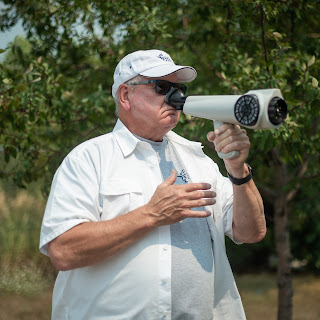
A fun and funny-looking instrument

Chuck McGinley, using a Nasal Ranger
Credit: Caroline Yang for The New York Times
Via the New York Times, a very interesting (and interesting-looking!) instrument: 
Chuck McGinley, a chemical engineer, stepped out of his car, eyed the smokestack of an animal processing plant rising above the treetops, and inhaled deeply. At first he smelled nothing except the faint, sweet fragrance of the nearby trees.

Suddenly, the wind picked up. “We have an oh-my-God smell!” Mr. McGinley exclaimed.

Immediately one of his colleagues pressed a Nasal Ranger to his nose. The 14-inch-long smell-measuring device, which looks like a cross between a radar gun and a bugle, is one of Mr. McGinley’s most significant inventions.

Pretty interesting article. Also, you could really imagine someone with a GC/MS strapped to their back, connected to the Nasal Ranger, collecting chromatograms while they were locating smells around their neighborhood.  

Monday, December 27, 2021

Romanian researchers want retractions of Elena Ceaușescu's papers

Via The Guardian, I learned that Elena Ceaușescu had chemistry monographs ghostwritten for her: 

Romanian researchers have called on academic publishers to remove Elena Ceaușescu’s name from almost two dozen scientific papers and books fraudulently published as her work, more than 30 years after the wife of the former communist dictator Nicolae Ceaușescu was executed.

Elena Ceaușescu was celebrated by state propaganda under her husband’s regime as a world-famous chemistry researcher, despite having no credible qualifications. The researchers say some of her work is still being cited and accessed, even though she was barely literate in science and unable to recognise basic formulas taught to first-year chemistry students.

They also want Ceaușescu’s honorary titles, awards and PhD to be revoked, and for institutions that honoured her – including the UK’s Royal Society of Chemistry and the Polytechnic of Central London (now the University of Westminster) – to withdraw recognition and acknowledge that her scientific career was bogus. Her PhD was never retracted in Romania, even though it was widely known she did not write it...

...“Her international fame was supported by forcing Romanian chemists to write papers, some of which were published in international journals, as well as a book that was translated in English and published by Pergamon Press, a widely known British academic publisher,” Isloi says.

That book – based on Ceaușescu’s PhD – was published by Pergamon under the title Stereospecific Polymerization of Isoprene and carries a foreword by the Nobel prize-winning British chemist Dorothy Hodgkin, who wrote: “I am not equipped myself with enough technical knowledge of the field of this work to give a critical scientific evaluation of its contents.

“But even a necessarily brief reading makes one think that the field of research surveyed by the author is vast and recent.”

There's a polite non-endorsement if there ever was one.