Showing posts with label chemical industry in the news. Show all posts

Friday, February 13, 2026

World's largest urea plant to be built in Nigeria

Via ChemAnalyst, this news (via a press release): 

Toyo Engineering Corporation is pleased to announce that its proprietary urea synthesis and granulation license has been selected for the world's largest urea plant planned by BUA Chemicals Limited ("BUA"), a chemical fertilizer manufacturer in Nigeria. The plant will consist of two production lines, each with a capacity of 4,000 tons per day.

The project is currently in the FEED (Front End Engineering Design) stage. With a view to future license provision, TOYO will serve as the licensor for urea synthesis and granulation, delivering the Process Design Package (PDP). 

I have long been curious as to the chemical industry in Africa, and it's pretty cool that the world's largest urea plant will be there. Will have to track its progress. 

Wednesday, May 28, 2025

Chemical plant explosion in Shandong province; 5 dead, 19 injured

Via South China Morning Post

An explosion at a chemical plant in Shandong province in eastern China on Tuesday has killed five people with a further six still missing, state broadcaster CCTV reported.

The explosion, which occurred at a site owned by Shandong Youdao Chemical in Gaomi city just before noon, also left 19 people injured.

The local emergency management bureau said on-site search and rescue operations and clean-up work had continued into the night.

The cause is yet to be determined.

The accident created a large fireball and sent clouds of smoke hundreds of metres into the air. Residents reported hearing a loud bang and said the blast had shattered the windows of many houses.

My sense is that this is one of the many thousands of smaller-scale (relatively speaking) chemical plants in China. Best wishes to the victims and their families. 

Monday, March 31, 2025

Celanese plant has acid spill on March 20

Via WDBJ: 

NARROWS, Va. (WDBJ) - Six people were injured Thursday morning in an acid spill at the Celanese Corporation chemical plant in Narrows. There were no fatalities, according to the company and the Giles County Sheriff’s Office.

Of the six victims, three are being treated at Carilion Giles Community Hospital; two are in critical condition, according to a Carilion spokesperson. The third is reportedly stable. One more victim was taken to LewisGale Hospital Montgomery, but has been released. The other two were not hospitalized.

Approximately 10 a.m. March 20, 2025. “a release of acetic acid vapor occurred in the Cellulose Acetate Unit at Narrows, Virginia, initially causing injuries to six employees. The release has been contained and is confined to the immediate area of the plant within the fenceline; no additional impact is expected,” according to a company spokesperson.

The Giles County Sheriff’s Office confirms, “The incident was contained to the Celanese Plant property and there no longer appears to be any danger to anyone in the area. The majority of emergency personnel have cleared the scene.”

This is a good reminder that acetic acid is pretty harmful stuff at industrial concentrations and volume. Best wishes to the victims. 

I'd love to understand how the release happened, but I'm guessing it was one of those "turned the wrong valve" situations... 

Monday, February 3, 2025

Dow cutting 1500 jobs

Via the AP, this bad news: 

Dow Inc.'s fourth-quarter profits came in well below Wall Street expectations and the material sciences company said Thursday that it is slashing 1,500 jobs globally in an effort to cut costs as sales stagnate.

The layoffs amount to about 4% of Dow’s workforce, according to data firm FactSet. Dow said the staff reductions are part of a broader plan to cut $1 billion in costs, citing “persistently weak macroeconomic conditions.”

Shares of Midland, Michigan-based Dow tumbled nearly 8% in morning trading.

Dow posted a loss of $35 million in the fourth quarter. Adjusted for one-time expenses, per-share profits in the period were zero. That’s down from last year’s earnings of 43 cents per share and well short of the 24 cents-per-share profit that analysts were expecting. For the full year, Dow recorded profits of $1.71 per share, down from 2023’s $2.24...

Here's hoping things turn around for the folks at Dow. Best wishes to them, and to all of us. 

Monday, November 25, 2024

CSB update on the BioLab fire in Conyers, GA

Via NBC, I see that the CSB has released its preliminary update on the Conyers, GA fire: 

Washington D.C. November 22, 2024 – Today, the U.S. Chemical Safety and Hazard Investigation Board (CSB) released an investigation update into the chemical reaction and toxic gas release on September 29, 2024, at the Bio-Lab, Inc. facility in Conyers, Georgia, that resulted in a massive fire and plume of toxic smoke that threatened the surrounding community and the metropolitan Atlanta area.

The reaction involved materials stored in a warehouse that generated heat, which led to the  decomposition of the product, the release of toxic vapors, and fires.  The primary substances involved in the reaction were trichloroisocyanuric acid (TCCA) and sodium dichloroisocyanurate (DCCA), along with bromochloro-5,5-dimethylimidazolidine-2,4-dione (BCDMH).  The resulting massive plumes of toxic smoke contained chlorine and other hazardous substances and caused significant offsite impacts. 

No major root cause updates as of yet, but the brown/red smoke is most likely from the bromo compound. Full report here.

Wednesday, November 13, 2024

Large explosion at Louisville, KY food coloring plant

credit: Michael Clevenger / Courier Journal 

Via WHII, this news: 
LOUISVILLE, Ky. — A large explosion was reported Tuesday afternoon in Louisville's Clifton neighborhood, and it wasn't the first time the factory experienced a hazardous materials incident.

MetroSafe confirmed a large explosion occurred in the 1900 block of Payne Street at about 3 p.m. 

Louisville Metro police advised the public to stay away from the area.

The business located at the address is the Givaudan Sense Colour company was formerly known as D.D. Williamson Company. It's known for producing the caramel color in soft drinks. 

D.D. Williams and Company started in 1865 and was bought by Givaudan Sense Colour in 2021. 

Givaudan Sense Colour also has facilities in the US, Ireland, and UK but they are headquartered in Louisville.

The Tuesday explosion is not the first time the plant on Payne Street has had issues.

In April 2003, one person was killed at the plant after a catastrophic vessel failure, according to the U.S. Chemical Safety and Hazard Investigation Board (CSB).
That building sure looks like it was a pretty bad explosion. I'd love to know what caused such a large explosion, but I suppose we'll find out eventually. 

Monday, September 30, 2024

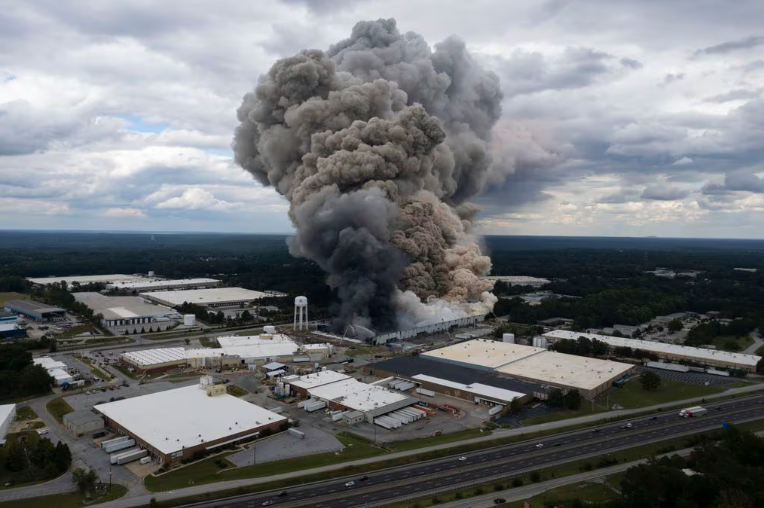
Sprinkler head causes major chemical release at BioLab trichloroisocyanuric acid facility in Conyers, GA

Ben Gray for the Atlanta Journal-Constitution
Via the Atlanta Journal Constitution: 

A fire reignited Sunday at a chemical facility in Conyers, officials said, forcing the evacuations of local residents and leading to several road closures, including I-20.

Officials said the blaze reignited after being contained Sunday morning at BioLab on Old Covington Highway, the third such incident at the plant over the past seven years. Photos showed a massive plume of smoke in the sky that was visible from Hartsfield-Jackson International Airport — about 30 miles away.

The fire started about 5 a.m. after a sprinkler head malfunctioned and mixed with a water-reactive chemical and wiring at the plant, Rockdale County fire Chief Marian McDaniel said during a press conference Sunday. She said they were working on removing the material away from the water source at the facility and that the fire was contained to the roof. There were employees inside the plant but no injuries have been reported at this time.

“Once we can get that chemical out of the building and allow it to burn off we’ll be in a much better shape,” McDaniel said.

...Over her seven years with the fire department, McDaniel said it was the third such incident of “this magnitude,” in which a product mixed with water and started a chemical reaction at the plant. She said the most recent incident likely happened in 2021. The Georgia Emergency Management and Homeland Security Agency (GEMA) said it issued a shelter in place order on behalf of Rockdale’s emergency management agency, but no timetable has been provided as to when the area will be safe.

I am rather chagrined to note that I was very aware of the BioLab facility in Lake Charles having a release in 2020, but not aware that the Conyers facility had two such releases in 2020 as well. (The CSB writeup of the Conyers releases starts on page 72, and seems to also involve inadvertent water exposure.) 

I am sure that the core problem is that "keep this stuff away from water" is harder than it seems, but I don't know, stopping major PR snafus and millions of dollars worth of preventable damage would seem to me to be important as well. I guess we'll have to read the new CSB report when it comes out. 

Monday, September 23, 2024

C&EN: "Dow lowers expectations for the 3rd quarter"

In this week's C&EN (article by Alex Tullo): 

Unexpected factors have forced Dow to lower its guidance for third-quarter performance. The company expects sales of $10.6 billion for the period, down from the $11.1 billion it forecast in July. Dow also predicts that earnings before taxes will be $1.3 billion. The company says it suffered an unplanned outage at one of its ethylene crackers in Texas in late July and has been hit by higher input costs in Europe, which are pinching profit margins. But Dow is getting a lift from higher selling prices and lower feedstock costs in North America.

It would be interesting to understand (maybe from the annual report) exactly how much of that $500 million adjustment could be attributed to the cracker being down - guessing the pressure to get it back up must be pretty high...  

Friday, August 30, 2024

C&EN: "Fires at 2 Indian plants kill many"

Via C&EN, this bad news (article by Aayushi Pratap): 

Fires broke out at two pharmaceutical chemical companies just days apart in southern India, killing more than 20 workers.

On Aug. 21, an explosion resulted in a fire at Escientia Advanced Sciences’ plant in the Anakapalle district of Andhra Pradesh state, an area known as a pharmaceutical hub. The blaze killed 18 workers and injured over 30 others. The 5-year-old company manufactures intermediate chemicals and active pharmaceutical ingredients.

According to Indian media outlets, the blast occurred during the lunch break, which prevented more people from getting injured or killed. But the vapor cloud caused by the explosion made it difficult for fire officials to rescue those trapped inside. The Press Trust of India news agency reported scenes of workers with peeling skin being rushed to the hospital.

Government officials told local news outlets that the company had 381 employees working two shifts. While an investigation is ongoing to identify the cause of the fire, officials suspect it was caused by faulty electrical equipment at the plant, according to media reports.

On Aug. 23, not far from Escientia, a flash fire at Synergene Active Ingredients was reported to have killed three workers and injured another. Local news outlets say the fire started during production of the blood pressure medicine losartan potassium.

Deepak Monga, a fire safety and evacuation expert based in Mumbai, India, says the incidents are a reminder of how safety is often overlooked at high-risk chemical plants in India.

“It was shocking to see that in the case of Escientia’s pharmaceutical plant explosion, the workers weren’t wearing personal protective equipment,” Monga says. He contends that companies cut corners and don’t invest in adequate fire safety protection and equipment, even though laws mandate it.

“It feels like these companies don’t value human life,” he says.

I would like to think that the Western world knows the human cost of purchasing its drugs from the developing world. Yes, audits exist, but not enough of them. Best wishes to the families of the victims. 

Monday, June 3, 2024

C&EN: "Dow presents rosy view of the future"

In this week's Chemical and Engineering News, this update on the status of Dow (article by Alex Tullo): 

While poor market conditions are getting many chemical industry managers down, the mood is upbeat at Dow. At a May 16 investor event, executives said they think the firm should be able to improve pre-tax earnings by more than $3 billion per year by the end of the decade. Many of the gains will come from its large low-carbon petrochemical project in Canada and through plastics recycling initiatives.

“It’s been 5 years since we spun out of DowDuPont. And I think if I could summarize the last 5 years, I feel like we’ve created a strong company with excellent operating discipline,” CEO Jim Fitterling told reporters before the event.

The company reported earnings before taxes of $5.4 billion in 2023.

The chemical industry is grappling with overcapacity after a frenzy of new plant construction in the US and Asia met with sluggish demand. Europe, which is among the highest-cost regions in which to make petrochemicals, has been hit particularly hard. Major players such as ExxonMobil and Sabic plan to close facilities in the region. And Dow competitor LyondellBasell Industries recently launched a review of its European operations...

I have a weird bias that "Dow doing well is good for US chemistry employment", but I sense that is probably 20 or 30 years old. Nevertheless, it's good that Fitterling thinks that good things are ahead for Dow. Here is hoping that he is right. 

Monday, April 29, 2024

C&EN: "Dow and BASF post upbeat first-quarter results"

In this week's Chemical and Engineering News, this good news (article by Alex Tullo): 

First-quarter financial results are out from Dow and BASF. And if these two chemical giants are setting the trend for their peers—which are due to report their results over the next several weeks—the industry may be turning the corner after a dismal 2023.

Dow’s sales fell 9.2% from the year-earlier period, while adjusted earnings slipped 5.1%. Sales and prices were down across all its business.

But compared with the fourth quarter of 2023, Dow’s sales and earnings were up 1.4% and 28.8%, respectively. A small decline in its core packaging and specialty plastics segment was more than offset by growth in its industrial intermediates and infrastructure business and its performance materials and coatings unit.

Excess capacity hit the petrochemical industry hard last year, particularly in high-cost regions such as Europe. But Dow CEO Jim Fitterling was upbeat during his April 25 conference call with analysts. “Most of the capacity is in the market already, and we’re seeing volume growth,” he said.

Dow’s own operating rates rose 10% in the first quarter, Fitterling reported. And he said lower-cost locales like the US and the Middle East should perform strongly. “We have been through the worst of it on the slowdown in the cycle,” he added.

BASF announced that it “got off to a solid start in 2024.” Its sales fell 12.2% and its earnings dropped 12.9% from the year-earlier quarter. The company attributes the decline primarily to lower prices. A few key businesses, such as chemicals, materials, nutrition, and personal care, saw improvements in volumes.

I used to think that basic chemical manufacturers' businesses were pro-cyclical (i.e. they do well when the broader economy does well), but the post-pandemic economy feels like that has broken that connection. Here's hoping that this good news means good news for the broader economy as well. 

Monday, March 11, 2024

C&EN: More cuts in the European chemical industry

In C&EN, this news (article by Alex Scott): 

Economic turmoil led to sales and profit declines at several major European chemical industry firms in the fourth quarter or all of 2023. Two big challenges for the sector are soft demand for its products and high energy prices. A number of companies, including Germany’s Evonik Industries, see no near-term uplift in market conditions.

Evonik says in its earnings announcement that it will respond to the “continuously challenging” market conditions with a program to cut annual costs by about around 400 million euros ($435 million). As part of the initiative, the firm will eliminate 2,000 jobs, 1,500 of which are in Germany. Many of the jobs will be management positions.

The company recorded a net loss of $159 million in the fourth quarter and a 17% decrease in sales to $4.0 billion. Evonik recorded an even bigger loss for the whole of 2023. “The general conditions will not get any easier, which is why we will continue our fundamental revamp of the group,” CEO Christian Kullmann told journalists at a briefing. “What we are currently experiencing are not cyclical fluctuations but massive, consequential changes of our economic environment.”

...Evonik’s announcement of job cuts follows a similarly downbeat briefing by BASF, which disclosed plans to cut expenditures by about $1.1 billion at its headquarters site in Germany by the end of 2026 because of high costs and slow demand. BASF already has a cost reduction program in place that will affect 700 workers.

Grim news out of Europe just continues week after week. Here's hoping it ends soon. 

Monday, March 4, 2024

Chemours CEO and CFO placed on leave due to earnings report problem

Via Delaware Online: 

Wilmington-based chemical giant The Chemours Co., a spinoff of the DuPont chemical empire, is in apparent tumult at the uppermost levels of management.

Three senior executive officers, including the CEO and chief financial officer, have been placed on leave, the company announced to investors Thursday morning.

Shares plunged after the announcement by nearly half at the start of trading Thursday morning, before recovering to $19 by noon — remaining approximately 33% lower than at the beginning of trading that morning.

Two weeks ago, Chemours failed to release its quarterly earnings report as scheduled. A director on the board, Sandra Phillips Rogers, also announced in February she would step down and that a new director would join the board on Friday, March 1.

Thursday's announcement hit the top levels of executive and financial leadership of the company and also signaled a full audit that includes outside counsel after apparent reports received to the company's ethics hotline.

"What we think many perceived as likely a relatively minor accounting hangup two weeks ago now appears wider, longer, and with more ramifications than the market initially believed," Barclays analyst Michael Leithead told Reuter's news service on Thursday.

I don't know much about large company finances, but I'm guessing it would take quite a number of people working together to cook the books. I wonder how long the problem has gone on? Best wishes to all those at Chemours. 

Friday, February 2, 2024

C&EN: "House bill targets some Chinese outsourcing firms"

This news (that I somehow missed) from friend of the blog Michael McCoy: 

The stock prices of the pharmaceutical outsourcing providers WuXi AppTec and WuXi Biologics were pummeled after a US House of Representatives committee introduced a bill that would restrict federally funded medical providers from using several Chinese outsourcing firms.

Based in Shanghai, WuXi AppTec is a top drug service provider and one of the world’s largest employers of chemists. WuXi Biologics is a separate company that WuXi AppTec spun off in 2017. The bill also mentions the private genomics firm BGI Group.

The draft bill, from the House Select Committee on the Strategic Competition between the United States and the Chinese Communist Party, cites US national security concerns. It says WuXi AppTec has sponsored “military-civil fusion” events in China and received investments from a military-civil integration investment fund.

The bill also says WuXi Biologics CEO Chris Chen was previously an adjunct professor at the People’s Liberation Army Academy of Military Medical Sciences. Similar legislation has been introduced in the Senate.

WuXi AppTec says in a stock market announcement the findings stated in the draft bill are not accurate. “We are confident that the business development of WuXi AppTec will not pose a security risk to any country,” it says. In its own announcement, WuXi Biologics says the bill references a courtesy designation that Chen received after a guest lecture in 2013.

The language of the draft bill states the following (I think I got the key section): 

The head of an executive agency may not procure or obtain any biotechnology equipment or service produced or provided by a biotechnology company of concern; or enter into a contract or extend or renew a contract with any entity that uses biotechnology equipment or services produced or provided by a biotechnology company of concern and acquired after the applicable effective date in subsection (c) in performance of the contract; or enters into any contract the perform-19 ance of which will require the direct use of biotechnology equipment or services produced or provided by a biotechnology company of concern and acquired after the applicable effective date in subsection (c). 

I have to say, I am pretty unimpressed with this. First, it will never make it out of Congress. Second, what federal organizations contract with WuXi for drug development services? None of them, I bet. Finally, Congress isn't dumb enough (I think) to say "welp, Merck (or whoever), you're just going to have to stop doing business with WuXi." This is a bluff, and a stupid one. 

Monday, January 29, 2024

C&EN: "Chemical earnings nose-dive in 2023"

In this week's C&EN, the latest comments on 2023 earnings from the major chemical companies, and it's not looking pretty... (article by Alex Tullo): 
Chemical companies’ 2023 financial results are starting to trickle in: with meek performance in Europe and China, a sluggish construction market, and industry-wide inventory destocking, it was an awful year for chemical makers. And company executives expect a turbulent start to 2024.

Dow, the first major chemical maker to report complete results, posted a 21.6% sales decline from 2022. Net income before unusual items dropped 64.9%.

Volume gains in Dow’s polyethylene and performance material and coatings businesses were more than offset by lower prices. “As we enter 2024, we expect near-term demand to remain pressured by elevated inflation, high interest rates, and geopolitical tension,” Dow chief financial officer Jeffery L. Tate said in a conference call with analysts.

BASF, the world’s largest chemical maker, had expected 2023 to be a terrible year, but the company revealed in a Jan. 19 preview that results would fall short of even its own dour expectations. Sales of $75.7 billion came in below the $79 billion–$82 billion that BASF had forecast in July. Its sales in 2022 were $94.7 billion.

Well, that's not really great news for hiring this year, but let's hope things turn around... 

Wednesday, January 24, 2024

Reuters: German chemical sector now hit by Red Sea Houthi conflict

Via Reuters, this news: 

FRANKFURT, Jan 22 (Reuters) - Germany's chemicals sector, Europe's largest, is starting to feel the pinch from delayed shipments via the Red Sea, becoming the latest industry to warn of supply disruptions that have forced some companies to curb production.

Crucial Asian imports to Europe ranging from car parts and engineering equipment to chemicals and toys are currently taking longer to arrive as container shippers have diverted vessels around Africa and away from the Red Sea and Suez Canal, following attacks by Yemen's Houthis.

..."My procurement department is currently working three times as hard to get something," said Martina Nighswonger, CEO and owner of Gechem GmbH & Co KG, which mixes and bottles chemicals for big industrial clients.

As a result of the delays, Gechem, which makes annual sales in the double-digit millions of euros, has lowered production of dishwasher and toilet tablets because it can't get enough trisodium citrate as well as sulfamic and citric acid.

The company is therefore reviewing its three-shift system, Nighswonger said, adding the ripple effects from the transport squeeze could remain a problem for the first half of 2024 at least. This is causing frank discussions with customers, Nighswonger added. "If we get three truck loads instead of six, each customer only gets part of their order quantity, but at least everybody gets something," she said.

Bigger speciality chemicals maker Evonik also said it was being hit by "short notice routing changes and delays", adding some ships had changed direction as many as three times within a few days.

The company said it was trying to mitigate the impact by ordering earlier and switching to air freight, which is considered a stopgap because some chemicals are not allowed to be transported by plane.

Sure wish the German chemicals sector got a better shake these days, but it sure doesn't seem like it...


Friday, December 1, 2023

C&EN: ACC predicts a sluggish 2024

Via C&EN's Alex Tullo, this grim news:

The US chemical industry had a tough 2023, and next year it will have to weather a tougher economic climate, possibly even a downturn.

That was the message delivered by the American Chemistry Council, a chemical industry trade group, in its industry forecast on Nov. 28. The ACC estimates that the industry’s output, excluding pharmaceuticals, will decline by 1.0% in 2023. It predicts a modest turnaround to 1.5% growth next year.

“We saw weakness really emerge last year in the third quarter, and it’s continued through much of this year,” ACC chief economist Martha Gilchrist Moore told reporters on a conference call.

...For example, Moore pointed out, student loan repayments are starting up again, credit card debt defaults are increasing, and consumers have worked through much of the savings they accumulated during the pandemic.

After posting 2.3% growth in gross domestic product in 2023, the US will experience economic growth of only 1.1% in 2024, the ACC expects.

There is this weird aspect of the economy these days, where there is a lot of negative data from standard economic indicators, and yet it does not yet seem to have shown up in the unemployment numbers (which, I imagine, are a lagging and not a leading indicator.) I do not wish it to be so (for many reasons) but I am concerned that 2024 will be a worse hiring year for industrially-oriented chemists than 2023, but I don't really have a great sense of this. 

Monday, November 27, 2023

C&EN: OSHA proposed penalties for PCI/Seqens

This update on the PCI Synthesis case (article by Rick Mullin): 

The US Occupational Safety and Health Administration has proposed nearly $300,000 in penalties for PolyCarbon Industries and its parent, the French firm Seqens, after an investigation indicated that an explosion at a PolyCarbon pharmaceutical chemical plant in Newburyport, Massachusetts, last May could have been prevented. The incident killed one worker, Jack O’Keefe, 62. OSHA cited 11 violations in its findings, including failure to determine the combustibility hazards of materials used in the process involved in the explosion. The incident was the third serious accident at the plant since 2020.

Here's some additional details from The Daily News of Newburyport: 

OSHA also found that Seqens/PCI Synthesis failed to: include safe upper and lower temperature limits to prevent the decomposition of Dekon 139; evaluate the consequences of deviation in the production process; establish written procedures to maintain the ongoing integrity of process equipment and provide clear instruction on consequences of deviation from steps in the operating procedures; update the process safety information to include steps to avoid consequences of deviation in temperature, properties and chemical hazards used in the process; update standard operating procedures for producing Dekon 139 and its safety data sheet; review a November 2022 compliance audit report with all affected personnel whose job tasks are relevant to the report findings; and track contract employees’ injuries and illnesses.

Hmmm, sounds like time to understand "Dekon 139" a little better for me...  

Wednesday, November 22, 2023

Did you learn about the Bhopal disaster?

Poster of "The Railway Men" 
Credit: Wikipedia
I'm spending more time on BlueSky these days, and less time on Twitter. I was struck by this question by a reporter the other day (undoubtedly brought on by the Netflix series "The Railway Men"): 

"Do people in the US still learn about the Bhopal disaster (in a not specialized course) or has it been memory holed?"

First, I want to quibble with the premise. As someone who basically remembers quite a bit about middle school and high school, I genuinely don't understand the concept of 'the memory hole' - we don't live in a world where facts are destroyed, so what do you mean? Do people mean "people forget about stuff" or do people mean "this fact that I think is important isn't talked about enough, in my opinion" or do people mean "this bit of news has been deliberately suppressed"? 

The other question is "what do you mean, 'learn (in a not specialized course)'"? We don't really have a place for learning about industrial disasters, other than history courses, and we don't really tend to cover industrial disasters in regular history courses, which tend to be about the formation of nation-states and the history of their governments. Chernobyl, for example, is a pretty grim instance of a Soviet-era industrial disaster, and the only place I could imagine seeing it in a US history course is in the "late Cold War" section as a part of the demise of the Soviet Union. While I consumed article after article in National Geographic about Chernobyl, I imagine that the average high schooler these days gets about 10 minutes. 

Setting that aside, I noted that I felt like the Bhopal disaster gets talked about in organic chemistry. I feel like, but I don't exactly remember, that I learned about methyl isocyanate either in undergrad, but definitely in graduate school. I have become quite the enthusiast about the work product of the Chemical Safety Board, so I certainly remember watching the Bayer CropScience video, which also talked about Bhopal. I'm probably both the exact right person to make the query ('is our children learning about Bhopal?') and exactly the wrong person to answer the question. 

So, reader - some questions for you: 

  • How old are you? (You can be vague) 
  • Did you learn about the Bhopal incident? 
  • When did you learn about it? Random reading, or in a class? 
  • Did you learn about methyl isocyanate in organic chemistry? 
  • If you're a professor of chemistry, have you taught about Bhopal? If so, what do you say? 
Thanks for your help. 

Monday, November 20, 2023

Chemicals plant in Louisiana to receive government funds to retool for battery chemical manufacture

Via the Louisiana Illuminator (a non-profit news website) this news:
ST. GABRIEL — A chemical plant in Louisiana that faced possible downsizing or even closure is now expanding to become America’s first domestic manufacturer of critical lithium battery materials thanks to new federal infrastructure investments.

Koura Global, which has a plant that makes fluorine refrigerants at its facility just south of Baton Rouge, will retrofit its facilities to manufacture lithium hexafluorophosphate (LiPF6), a primary component in lithium-ion batteries. At full capacity, the plant will produce enough of the chemical to make more than a million electric vehicle (EV) batteries a year.  

U.S. Rep Troy Carter, D-Louisiana, who represents the 2nd Congressional District between New Orleans and Baton Rouge, told Koura’s employees Friday that their work will address a “critical gap in our domestic supply chain” for lithium-ion batteries.

The plant currently manufactures a fluorine refrigerant that is being replaced with a more environmentally friendly chemical. Koura will retrofit its current operations to produce the new refrigerant, but a $100 million U.S. Department of Energy grant will allow the company to construct new facilities at the plant to pivot into the battery industry, according to Koura executive Erick Comeaux.

The grant is one of thousands made available under the Bipartisan Infrastructure Law that President Joe Biden ushered through Congress in 2021. Also known as the Infrastructure and Investment Jobs Act (IIJA), the plan is the country’s largest federal infrastructure investment in decades. It includes money for investments in domestic manufacturing, transportation, energy, drinking water systems, environmental remediation and broadband internet expansion, among other things.

It sure feels like the number of active fluorochemical manufacturers isn't growing in the US, so this is a clever shift. Here's hoping it works out for them.