Monday, November 4, 2024

Harvard Crimson: Charles Lieber to visit Beijing for "employment networking"

Via the Harvard Crimson, this unusual news: 

A federal judge gave former Harvard Chemistry professor Charles M. Lieber permission to visit China for “employment networking” and give a lecture in Beijing — nearly three years after Lieber was convicted for lying to federal investigators about his relationship to China.

Lieber is currently serving a 18-month term of supervised release after completing six months of house arrest.

Lieber has been actively searching for employment in China since at least June, when he asked a judge if he could visit the University of Hong Kong the next month “to discuss potential faculty appointment and employment opportunities.”

In July, Lieber requested to attend the International Beijing Brain Conference in August to deliver a keynote speech and “discuss research and potential collaborations with local students.”

All three of Lieber’s requests were approved by U.S. District Judge Denise J. Casper. The most recent request, which Casper signed off on last week, did not specify Lieber’s planned dates of travel.

In the requests, Lieber’s attorneys wrote that they had sought approval for Lieber’s travel from the Chinese consulate but had not heard back.

The Crimson could not determine whether Lieber has visited China yet, and neither Lieber nor his attorneys responded to requests for comment. In August, he told the South China Morning Post via email that he had “not yet visited Hong Kong, but may do so this fall.”

In some sense, this is reasonable, i.e. China pays significant money to be associated with prominent academics, and Charles Lieber is certainly very prominent. Also, I presume that he needs employment. However, it was his past associations with Chinese academia that got him into trouble, and in that sense, this move is rather surprising. I guess we'll see where Dr. Lieber ends up. 

C&EN on horseshoe crab blood testing

In the latest issue of C&EN, this fascinating feature by Laurel Oldach:

At a recent meeting of the Parenteral Drug Association, where industry microbiologists discussed ways to make drugs without a trace of unwanted biological material, photos of horseshoe crabs danced across a screen between sessions. The sediment-snuffling arthropod with a dozen legs and a shell like a helmet may seem like an unlikely pairing with the sleek, highly engineered robotics of a pharmaceutical production line. But estuaries teeming with life and clean rooms where it should be all but absent are linked by their dependence on this animal.

That is poised to change. In November, US regulators will formally announce their acceptance of alternatives to a key test that ensures drug products are not contaminated. The new tests will use proteins produced in bioreactors rather than in wild horseshoe crabs.

The change was hard fought. Arguments played out in the technical literature and in expert committee meetings. The stakes included hundreds of millions of dollars in annual sales for the company with the most to lose from a switch and the professional reputations of a group of industry insiders who were fired from their volunteer jobs. Now it appears that the tide may be turning on endotoxin tests made from horseshoe crab blood—but it hasn’t gone out just yet.

This piece is pretty long and detailed, but it is definitely worth it, as it explains the rather labyrinthine process of changing USP standards, and how it is its own bureaucratic battlefield. Read the whole thing. 

Friday, November 1, 2024

Have a great week

This has been kind of a wild week, but here I am, I guess, with a larger project due. At least I got a couple of decent meals out of it. Hope you had a great week, and have a great weekend. See you on Monday. 

Meet a candy scientist and their IP

Via the Wall Street Journal, this fun bit of intellectual property trivia: 

...Taste testers wanted more flavor and felt the chewing experience wasn’t gummy enough, so Ferrara made the product even tangier and tweaked the crunch-to-chew ratio. 

In the summer of 2020, the candy company and the inventor of Nerds Gummy Clusters, a Ferrara scientist named Sean Oomens, filed for a patent on a “dual-textured confectionery” with a “chewy center” and “crunchy coating.” 

The details in the application, which is pending, included an exact definition of gummy (“a springy, resilient character with varying degrees of firmness”) and a less exact shape of the cluster (“generally ovoid, spherical or bean-shaped”). 

...Ferrara’s experiments with Gummy Clusters did result in batches of soggy Nerds, according to a person familiar with the process. The patent on Gummy Clusters suggests that Ferrara’s candy scientists solved their problem with additives such as gum arabic, an additive that prevents moisture from the chewy center from seeping into the candy pebble’s coating...

I bet it's a lot of fun to be a candy scientist, but you probably have a serious salt tooth at the end of a work day... 

makes you wonder who the PHOSITA for candy science would be... 

Thursday, October 31, 2024

Job posting: Head of R&D, Sironix Renewables, Seattle, WA

Via BlueSky, this position: 

About us: We’re a startup company with proven technology developing eco-friendly and bio-renewable surfactant chemicals for consumer products, such as laundry detergents and personal care products. Sironix has invented and developed a series of new surfactant molecules that will make our consumer products work better and benefit our environment. We have received over $7M in government investment and partnerships along with recent venture funding. We are searching for an applicant who can help us refine and scale our surfactant manufacturing process, overcome barriers to technology commercialization and achieve a more responsible future for the cleaning and personal care industry.

Summary: As Head of Research and Development at Sironix Renewables, you will be joining a company at the forefront of green chemistry, bio-renewables, and product development. You will be aiding the development and scale-up of surfactant production methods as we transition from pre-pilot toward commercial scale manufacturing. Responsibilities primarily involve coordinating with contract and chemical manufacturers to de-risk and scale manufacturing processes, designing and implementing experimental plans to meet customer product specifications, supporting R&D efforts as they relate to intellectual property and grants management, as well as performing equipment maintenance as required. 

They will lead a small team of full-time research scientists while managing relationships with contract engineers. Quality control, including use and maintenance of chromatography, spectroscopy and surfactant performance test instrumentation, will be an important focus to assure our product continues to meet our standards as scaling continues. Tasks require management of simultaneous research projects, effective communication with customers, collaborators, and other team members, as well as auxiliary technical tasks outside of typical lab work to help grow our business. As is the nature of research, creative problem solving is required in order to ensure consistent and confident data. The working conditions and fellow employees are relaxed, but we are motivated and determined to build a name for ourselves and change the way the world cleans!

Salary: A starting salary of $110,000 to $150,000 per year is expected.

Required Experience & Qualifications

  • Ph.D. in Chemistry, Chemical Engineering, Process Engineering, or related Engineering discipline with 2 years of relevant industry experience, or M.S. with 4 years of relevant industry experience, or B.S. with 6 years of relevant industry experience required
  • Excellent written and verbal communication skills
  • Experience working independently to design and implement chemistry experiments in the laboratory, including demonstrated wet chemistry skills as well as analytical and problem-solving skills to interpret and refine results
  • High mechanical aptitude and knowledge of mechanical concepts needed to maintain, troubleshoot and repair mechanical equipment and electrical device

Full ad here. Best wishes to those interested. 

Wednesday, October 30, 2024

C&EN: Chemistry undergraduate enrollment falling faster than all programs

Friend of the blog Leigh Krietsch Boerner has a great feature in Chemical and Engineering News tackling the problem of undergraduate enrollment in chemistry. The whole article is worth reading, but this analysis by Leigh is the most important: 

...According to data from the National Student Clearinghouse Research Center, enrollment at 4-year colleges in the US has dropped 3.2% since 2019. Enrollment in chemistry programs, meanwhile, has tumbled 23.2% over the same period.

In contrast, undergraduate enrollment in biology fell about the same amount as all undergraduate enrollment since 2019. And at a time when college enrollment is dropping and students are opting out of higher education, the number of biology degrees has actually increased since 2019. According to C&EN’s analysis, the number of undergraduate degrees awarded in biology has gone up 7.5% since 2019. During the same period, the number of bachelor’s degrees in all disciplines dropped by 2.6%, while chemistry degrees were down 14.1%.

As of the end of the 2023–24 academic year, only a few hundred more schools offered degrees in biology than in chemistry. And in the past 5 years, the number of programs in each discipline has fallen at about the same rate. But according to C&EN’s analysis, US higher education institutions awarded 132,465 biology degrees in 2023, compared with 12,567 chemistry degrees. And schools don’t seem to be ending their biology programs.

It seems reasonable to conclude this isn't going to do great things for chemistry as a field in the United States, nor chemistry employment (for chemists) nor for the number of non-R1 chemistry faculty positions. Here's hoping that we see a turnaround. Read the whole thing. 

Tuesday, October 29, 2024

The 2025 Chemistry Faculty Jobs List: 378 research/teaching positions and 41 teaching positions

The 2025 Chemistry Faculty Jobs List (curated by Andrew Spaeth and myself) has 378 research/teaching positions and 41 teaching positions 

Want to help out? Here's a Google Form to enter positions.

To see trending, go to Andrew Spaeth's visualization of previous years' list.

On October 31, 2023, the 2024 Chemistry Faculty Jobs List had 415 research/teaching positions and 38 teaching positions.

Want to talk anonymously? Have an update on the status of a job search? Go to the first open thread. 

Don't forget to click on "load more" below the comment box for the full thread. 

Are you having problems accessing the Google Sheet because of a Google Documents error? Email me at chemjobber@gmail.com and I will send you an Excel download of the latest sheet. 

The Chemical Engineering Faculty Jobs List: 95 research/teaching positions and 14 teaching positions

The Chemical Engineering Faculty Jobs List (by Heather LeClerc and Daniyal Kiani) has 95 research/teaching positions and 14 teaching positions. 

Here is a link to the open thread for the year.

Monday, October 28, 2024

C&EN: "Rigoberto Hernandez elected 2025 ACS president-elect"

Via C&EN (article by Sara Cottle), this ACS news:

Rigoberto Hernandez has been elected the 2025 American Chemical Society president-elect by ACS members. Hernandez will serve as society president in 2026 and immediate past president in 2027. These roles include serving on the board of directors from 2025 to 2027.

ACS members also elected four other people into ACS governance positions, including the first-ever International District director.

...In other election news, Katherine L. Lee, executive director and head of scientific planning and operations in the Inflammation and Immunology Research Unit at Pfizer, was re-elected District I director for 2025–27, defeating Matthew Grandbois, vice president of business development at AirJoule.

Silvia S. Jurisson, a professor of chemistry and radiology at the University of Missouri, was elected District V director for 2025–27, defeating two other candidates, Lisa M. Balbes, independent consultant at Balbes Consultants, and Mark C. Cesa, retired from Ineos Nitriles.

David Wu, director and research fellow at the Institute of Chemistry at Academia Sinica, was elected ACS’s first ever International District director for 2025–27, defeating Hooi-Ling Lee, an associate professor at the School of Chemical Sciences at Universiti Sains Malaysia. The petition creating this position was approved by the ACS Council and Board of Directors in August 2023 and ratified by the members in November 2023.

Natalie A. LaFranzo, vice president of strategy at the Linus Group, was re-elected director-at-large, defeating Sergio Nanita, a senior principal investigator at Incyte.

Best wishes to ACS President-elect Hernandez and the other new BoD members.

Friday, October 25, 2024

Have a great weekend

A short week always feels a bit like playing hooky. I hope that you had a great week and that you got what you needed to get done, done. Hope you have a great weekend, and see you on Monday. 

Harry Elston's book "Thrive Solo", reviewed

Credit: Harry Elston
Harry Elston is a long-time friend of the blog, and he's written a good book about being a solo
entrepreneur, titled "Thrive Solo." It's written about his experience becoming a full-time consultant in chemical safety. 

I read it pretty quickly, and as someone who has talked to a lot of aspiring and current entrepreneurs, it was both very informative and covered a lot of questions that I feel many potential entrepreneurs have. 

The section on "how to do your own accounting" was an important section for me that I haven't read very much about. In addition, his approach to "types of contracts" was illuminating for me as well. 

One aspect that I really liked about Harry's approach to the various sections was first reviewing the subject (taxes, corporate structure, etc) and then saying "this is how I do it, and why." It's good to both have the basic structure, and then the author's opinion on what worked best for him, and why. 

The book is well-written and short. I didn't see any particular weaknesses, but this is the moment in a book review where you're supposed to say something that needs improvement, so I'll say this: There are precious few personal experiences within "Thrive Solo". I've had enough breakfasts and phone calls with Harry to know that he can tell a good story, but that aspect of his personality doesn't really come out in this book. More Harry next time, please. 

It's also quite inexpensive (especially on Kindle.) If you're thinking about striking out on your own as a consultant, I would definitely recommend picking up a copy. It's a good investment for a first step to a potential new career. 

Thursday, October 24, 2024

Job posting: analytical chemist, Nestlé Purina Analytical Laboratories, St. Louis, MO

Via Indeed, this position: 

Quality Assurance and Nestlé Purina Analytical Laboratories department is comprised of talented individuals who possess a genuine love for pets and their families. We thrive on being at the forefront of research, contributing to the innovation and advancements in pet nutrition and quality that sets Nestlé Purina apart. Ensuring the delivery of safe ingredients and sustainable practices to our factories and beyond, we are invigorated by the extensive research and development that goes into our products. Bring your impact to the table and together we will continue to work towards being one of the most trusted companies in pet care.  

As an Analytical Chemist, you will execute and interpret complex procedures and protocols within a project or goal. You’ll be a great fit if you are a self-starter who takes initiative and works independently while collaborating within Nestlé Purina Analytical Laboratories (NPAL). You’ll be expected to learn method development, make process improvements, and help draft standard operating procedures (SOP’s) in addition to mentoring other team members.

Requirements

  • Bachelor’s degree in Chemistry or a related field
  • 3+ years of analytical lab or industry experience, analytical instrumentation experience, and troubleshooting of assay and equipment issues
  • 2+ years of experience with chromatography and/or mass spectrometry (HPLC, GC, GCMS, LCMS, etc.)

The approximate pay range for this position is $59,000.00 to $85,000.00.

Full ad here. Best wishes to those interested.

Wednesday, October 23, 2024

Can there only be one Kate the Chemist?

In a recent issue of Chemical and Engineering News, this very enjoyable profile of Dr. Kate Biberdorf, popularly known as Kate the Chemist (article by Dalmeet Singh Chawla): 

...That hustle has paid off for Biberdorf. After 16 years studying and working in Texas, she recently moved to the University of Notre Dame to become the institution’s first-ever professor for the public understanding of science.

The role will be significantly different from what Biberdorf did at UT Austin, where her whole job was to teach chemistry. Alongside that day job, every week she would visit up to four schools, engaging with more than 20,000 students a year. “My best year was 29,000 students, and that was a really good year, but I was very tired,” she says. “When I’m breathing fire, and I often do it in Louboutin heels, people just take notice.”

It sounds like it's reasonably lucrative for her: 

...In 2020, she handed over the unpaid school outreach work to someone else at the university. Now Biberdorf has two literary agents, a social media agent, a podcast agent, and a sponsor agent. She is a client of the United Talent Agency, which represents artists, athletes, entertainers, and more. Twenty percent of all the fees she earns for any show usually go to the agency, and 10% to Schwartz, who is still her manager.

Biberdorf declines to share any monetary figures, citing confidentiality agreements, but says her Kate the Chemist gig makes “so much more money” than her professor role at UT Austin did. “It’s an extreme amount of money you can make with these sponsorships.”

It also sounds like she will be doing a fair bit of work for the University of Notre Dame, her new employer: 

...She has officially moved to Notre Dame, where she says her role will be a more natural fit with her science entertainer work. It will be business as usual under the Kate the Chemist brand. But with more freedom from her institution and no chemistry classes to teach, she says she can focus on her science communication work and ultimately bring more attention to the scientific research taking place at Notre Dame. “It’s a win-win,” she says.

“They’re building me an entire studio,” she says. It’s a camera-friendly laboratory, a makerspace, and it’s going to be open on Feb. 1, Biberdorf notes. “Notre Dame is invested in this.”

In her new position, Biberdorf hopes to launch the university’s first major in science communication, with the aim of creating an “army of science communicators.” For now, she will start off with a science communication minor.

I have long been skeptical of the labor economics of science communication, especially as a stand-alone career. I've thought about this for years, especially since I know that so many people would like to do 'science communication'* as a job, and I have watched what seems like hundreds (but is probably more like 10 or 20 professional freelance science communicators) struggle over the years as I've watched on the sidelines on social media since 2010 or so. 

I can't help but note that my skepticism has long been rooted in Derek Lowe's skepticism about his prospects as a professional science communicator. I can't find the quote but (like so many quotes from Derek), it's eminently memorable - if living solely on the checks from his writing, he and his family would soon be reduced to eating the grass in his backyard. Derek's a much, much better writer than I, so what chance do I have, or anyone else for that matter? I have a family to support, so I'm not a writer, I work for a living in chemical manufacturing.**

But this isn't really about me and my inadequacies - it's actually about the core of this blog's mission over the years, which is to attempt to quantify the quality of job markets. The latest Occupational Outlook Handbook (updated in August 2024) indicates that there are something like 87,000 chemists, and their median pay is ~$85,000 a year. While we can debate whether this is a good salary or a bad one, I think you can argue that you can live on your own (probably not very well, depending on where you live) and with luck, finding an appropriate spouse or a partner with a similar annual salary would be a great way to extend your dollar and increase your standard of living to something approaching the great American dream of affluence.

I'm not so sure about professional science communicators of any sort. As I've said before, professional science communication (especially the kind that makes money) seems to be mostly part of the entertainment industry, and entertainment seems to be a labor tournament market, where there are many entrants, but one true winner (and just a few people who make a median income competing.) Kate is winning that tournament (and seems to have won another one, in her (I presume) tenured position at Notre Dame.) That is great for her, but this is not a reproducible path. I genuinely do not understand what a long-term, high-quality employment market for science communicators looks like. I posit that I've never seen one, and more's the pity. 

*What the hell is 'science communication' anyway? I know it when I see it, as do you. 

**I note that I am STILL very proud to be a member of NAICS 325. 

***One more CJ-esque note: I cannot help but note Dr. Biberdorf is moving from a classically large public university to a private university. This too is the correct move in Our Modern Times.

Tuesday, October 22, 2024

The 2025 Chemistry Faculty Jobs List: 368 research/teaching positions and 38 teaching positions

The 2025 Chemistry Faculty Jobs List (curated by Andrew Spaeth and myself) has 368 research/teaching positions and 38 teaching positions 

Want to help out? Here's a Google Form to enter positions.

To see trending, go to Andrew Spaeth's visualization of previous years' list.

On October 31, 2023, the 2024 Chemistry Faculty Jobs List had 415 research/teaching positions and 38 teaching positions.

Want to talk anonymously? Have an update on the status of a job search? Go to the first open thread. 

Don't forget to click on "load more" below the comment box for the full thread. 

Are you having problems accessing the Google Sheet because of a Google Documents error? Email me at chemjobber@gmail.com and I will send you an Excel download of the latest sheet. 

The Chemical Engineering Faculty Jobs List: 85 research/teaching positions and 14 teaching positions

The Chemical Engineering Faculty Jobs List (by Heather LeClerc and Daniyal Kiani) has 77 research/teaching positions and 14 teaching positions. 

Here is a link to the open thread for the year.

Monday, October 21, 2024

C&EN: "SQM to supply SK with iodine for refrigerants"

Via C&EN, this news (article by Craig Bettenhausen: 

The Chilean mining company SQM will provide the iodine needed for next-generation refrigerants that the specialty chemical maker SK Enmove, a subsidiary of SK Innovation, is developing. SK says that in addition to carrying a lower global warming impact than fluorine-based options, the iodine refrigerants work better in the heating cycle, making them more useful in electric vehicles that cannot depend on waste heat for cabin heating. SK is working with Hyundai to commercialize heat pump systems based on the new refrigerants.

Who knew that PTA production requires cobalt? (This paper (PDF) did, but I didn't (it's part of an oxidant, apparently.) 

It would be interesting to know how much cobalt would be required for a single Coke bottle's worth of PTA/PET as opposed to a cell phone's need. 

Friday, October 18, 2024

Have a good weekend

Well, it's good to be back in the office this week. I got a last-minute reprieve on a project, which was awfully nice. I hope that you had a good week, and that you have a great weekend. See you on Monday! 

Thursday, October 17, 2024

Job posting: Product Development Specialist, 3M, St. Paul, MN/hybrid

Via C&EN Jobs: 

As a Product Development Specialist for IATD’s adhesive products in consumer electronics, you will have the opportunity to tap into your curiosity and collaborate with some of the most innovative and diverse people around the world. Here, you will make an impact by:

Leading cutting edge high-strength adhesive technology development with direct customer applications for key consumer electronics products  

Supporting winning business in a fast-paced environment through evaluation and optimization of material characterization techniques to ensure high accuracy and alignment with our customers innovative designs and functional requirements

Bringing in versatile material and technology knowledge, and maintaining external engagement and expertise to enable disruptive new adhesives properties

Your Skills and Expertise 

  • To set you up for success in this role from day one, 3M requires (at a minimum) the following qualifications:
  • Master’s degree or higher in Chemical Engineering, Chemistry, Polymer Science, Polymer Engineering, Materials Science
  • Three (3) years of combined experience in adhesives or composites in a private, public, government, educational or military environment.

Additional qualifications that could help you succeed even further in this role include:

  • PhD in Chemical Engineering, Chemistry, Polymer Science, Polymer Engineering, Materials Science
  • Experience in one or more of the following: material modeling, mechanical testing of materials, organic molecule synthesis (from small molecule to polymers), scale up processes
  • Experience with consumer electronics materials requirements
  • Five (5) year of combined experience in adhesives or composites in a private, public, government, educational or military environment
Full ad here. Best wishes to those interested. 

Wednesday, October 16, 2024

Hydrogen sulfide leak at PEMEX facility kills two last Thursday

Via CNN, this sad news from last week: 

A chemical leak at a PEMEX oil refinery in Deer Park, Texas, on Thursday killed two workers and injured several others, prompting temporary shelter-in-place orders for residents across the city, officials said.

The leak happened around 4:20 p.m., sending hydrogen sulfide – a colorless and potentially toxic gas – seeping into the air at the plant, according to Harris County Sheriff Ed Gonzalez.

Two bodies have been found at the scene and at least 35 others were “triaged,” the sheriff said at a Thursday night news conference. It is unclear how many were treated on-site or brought to a medical facility.

PEMEX, a Mexico-based oil company, said in a statement in Spanish that operations were halted once the leak was detected and local authorities were notified.

Shelter-in-place orders were issued for the city of Deer Park, as well as some residents of neighboring Pasadena, as emergency officials told residents to stay indoors, close all windows and doors, and turn off their air-conditioners. The orders have since been lifted after air monitoring determined no hazardous chemicals had permeated the surrounding community, city officials said.

“We’ve not gotten any air monitoring reports to show that anything has gotten into the community that would be a concern to any constituents in Deer Park,” Deer Park Mayor Jerry Mouton said, noting air monitoring will be ongoing.

Hydrogen sulfide, commonly used in oil and gas refining, has a pungent “rotten egg” smell that may linger in the air, Mouton said.

I wasn't aware that hydrogen sulfide was used in oil and gas refining. CSB is deploying, so I imagine that we will come to understand more (I hope.) 

Retraction Watch: "Retractions begin for chemist found to have faked data in 42 papers"

Via Retraction Watch, this news: 
A nanotube researcher in Japan has earned 13 retractions, with more to come, after an extensive investigation by the country’s National Institute of Advanced Industrial Science and Technology (AIST) revealed widespread misconduct in his work. 

AIST’s investigation found Naohiro Kameta, senior principal researcher at the Nanomaterials Research Institute located in AIST’s Ibaraki campus, fabricated and falsified dozens of studies. He was apparently dismissed from his role following the findings. 

The institute first learned of the problems in Kameta’s work in November 2022, according to a translated version of the investigation report. Initially, they looked into five papers, but eventually expanded their scrutiny to 61 articles on which Kameta was the lead or responsible author...
It would be really interesting to understand how the retraction and official governmental sanctions process works for serious scientific misconduct. 

Tuesday, October 15, 2024

The 2025 Chemistry Faculty Jobs List: 349 research/teaching positions and 33 teaching positions

The 2025 Chemistry Faculty Jobs List (curated by Andrew Spaeth and myself) has 349 research/teaching positions and 33 teaching positions 

Want to help out? Here's a Google Form to enter positions.

To see trending, go to Andrew Spaeth's visualization of previous years' list.

On October 17, 2023, the 2024 Chemistry Faculty Jobs List had 384 research/teaching positions and 34 teaching positions.

Want to talk anonymously? Have an update on the status of a job search? Go to the first open thread. 

Don't forget to click on "load more" below the comment box for the full thread. 

Are you having problems accessing the Google Sheet because of a Google Documents error? Email me at chemjobber@gmail.com and I will send you an Excel download of the latest sheet. 

The Chemical Engineering Faculty Jobs List: 77 research/teaching positions and 14 teaching positions

The Chemical Engineering Faculty Jobs List (by Heather LeClerc and Daniyal Kiani) has 77 research/teaching positions and 14 teaching positions. 

Here is a link to the open thread for the year.

Monday, October 14, 2024

C&EN on methanol adulteration in drinking alcohol

In last week's C&EN, this fascinating article (article by Puja Changoiwala):

Starting on a Wednesday morning in June, 225 people were admitted to four hospitals in the southern Indian state of Tamil Nadu. Their symptoms included vomiting, stomachache, headache, diarrhea, and eye irritation.

To support the medical staff, the government brought in extra doctors from nearby medical schools. Yet 65 of the 225 patients did not survive. Their cause of death was the same—they had all consumed methanol-laced illicit liquor, purchased from local bootleggers.

“The victims included men and women; essentially, the poor. Most of them worked as manual or agricultural laborers, and they consumed the spurious liquor because it’s cheap,” says M. S. Prasanth, the top government official in the district of Kallakurichi, where the incident occurred. “It’s a problem controlling methanol. A detailed inquiry has been ordered by the Tamil Nadu government to probe the tragedy.”

It is remarkable to me how important the correct setting of public policy (such as tax policy)  is to prevent bad outcomes like methanol poisoning.* 

*Cases like this seem to indicate that societal norms such as 'don't adulterate potable items with poisons' come with sufficient societal wealth. What a grim comment on humanity.

C&EN: "SK Pharmteco to set up a new peptide plant"

In last week's C&EN, this news (article by Aayushi Pratap): 

SK Pharmteco, a contract development and manufacturing organization, plans to invest $260 million in a peptide and small-molecule drug production plant in Sejong, South Korea. The 12,600 m2 facility will be the company’s fifth plant in that country. SK Pharmteco says the plant will be operational in late 2026 and add 300 employees to its workforce. The high global demand for peptides is fueled in part by the popularity of glucagon-like peptide-1 drugs, such as those developed by Novo Nordisk and Eli Lilly and Company.

It's kind of wild to me how many new peptide facilities are being set up - terribly curious to know if they will all be running in a year or five.  

Friday, October 4, 2024

Have a great weekend

Some weeks cannot be busier. I hope you had a more peaceful week than me, but I'm fine. Hope you have a great weekend. See you on Monday! 

C&EN: "Some tattoo inks in Europe contain banned pigments"

This news via C&EN's Krystal Vasquez: 

A new study that analyzed 10 inks commonly used in Europe found that 9 of them were out of compliance with the European Union’s Registration, Evaluation, Authorization, and Restriction of Chemicals (REACH) regulation (Analyst 2024, DOI: 10.1039/D4AN00793J).

Nine tattoo inks were found to be noncompliant with the European Union's Registration, Evaluation, Authorization, and Restriction of Chemicals regulation.

Under REACH, makers of tattoo inks and permanent makeup are required to list the products’ ingredients and reduce or eliminate compounds that could pose a risk to human or environmental health. For example, REACH recently banned two pigments common in blue and green inks, pigment green 7 and pigment blue 15:3, that the EU had also previously banned in hair color.

Of the nine noncompliant inks, the researchers determined that five had minor discrepancies; these inks did not contain any banned pigments, but their labels didn’t list all their ingredients. But four inks contained the banned pigment green 7, and two contained a variant of pigment blue 15. The researchers were unable to conclusively determine using their main method of analysis, Raman spectroscopy, whether the variant was the banned pigment blue 15:3.

Pretty interesting analysis - read the whole thing. 

I guess I don't really understand why there is an expectation (even in Europe) that tattoo inks would follow EU chemical regulations. (Who enforces REACH in EU countries, anyway?) Do people looking for tattoos ask about this? Is there a German Tattoo Safety Agency? 

Thursday, October 3, 2024

Job posting: Senior Scientist - Data Science, Analytical Research and Development (Onsite), Merck, Rahway, NJ

Via Twitter, this position at Merck: 
The Analytical Research and Development organization in Rahway, NJ is seeking a motivated Senior Scientist with technical expertise in data science and an ability to apply digital solutions to support our Company's pipeline of small molecule drugs, peptides, biologics, and vaccines. This role will allow the candidate to solve complex scientific challenges through application of data modeling, analysis, and visualization tools. 
The successful candidate is expected to collaboratively work with synthetic, computational, and analytical scientists, understand their problem statements, and collaboratively implement and apply data science solutions. The candidate must be able to work proactively and independently and influence decisions and solutions spanning a wide diversity of problem statements across our Company Research Laboratories. The role will require the candidate to network across a range of departments and effectively collaborate with stakeholders. The candidate should exemplify positive ways of working which support diversity, inclusion, and a positive culture. The chosen candidate should have a demonstrated ability to publish and present research, including an established track record of interaction with the broader scientific community.

 Full ad here. Best wishes to those interested. 

Tuesday, October 1, 2024

The 2025 Chemistry Faculty Jobs List: 313 research/teaching positions and 26 teaching positions

The 2025 Chemistry Faculty Jobs List (curated by Andrew Spaeth and myself) has 313 research/teaching positions and 26 teaching positions. 

Want to help out? Here's a Google Form to enter positions.

To see trending, go to Andrew Spaeth's visualization of previous years' list.

On October 3, 2023, the 2024 Chemistry Faculty Jobs List had 329 research/teaching positions and 24 teaching positions.

Want to talk anonymously? Have an update on the status of a job search? Go to the first open thread. 

Don't forget to click on "load more" below the comment box for the full thread. 

Are you having problems accessing the Google Sheet because of a Google Documents error? Email me at chemjobber@gmail.com and I will send you an Excel download of the latest sheet. 

The Chemical Engineering Faculty Jobs List: 57 research/teaching positions and 11 teaching positions

 The Chemical Engineering Faculty Jobs List (by Heather LeClerc and Daniyal Kiani) has 57 research/teaching positions and 11 teaching positions. 

Here is a link to the open thread for the year.

Monday, September 30, 2024

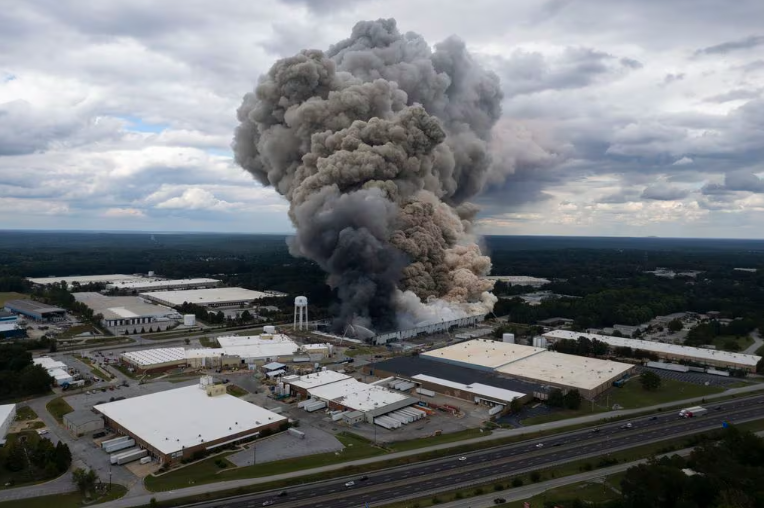
Sprinkler head causes major chemical release at BioLab trichloroisocyanuric acid facility in Conyers, GA

Ben Gray for the Atlanta Journal-Constitution
Via the Atlanta Journal Constitution: 

A fire reignited Sunday at a chemical facility in Conyers, officials said, forcing the evacuations of local residents and leading to several road closures, including I-20.

Officials said the blaze reignited after being contained Sunday morning at BioLab on Old Covington Highway, the third such incident at the plant over the past seven years. Photos showed a massive plume of smoke in the sky that was visible from Hartsfield-Jackson International Airport — about 30 miles away.

The fire started about 5 a.m. after a sprinkler head malfunctioned and mixed with a water-reactive chemical and wiring at the plant, Rockdale County fire Chief Marian McDaniel said during a press conference Sunday. She said they were working on removing the material away from the water source at the facility and that the fire was contained to the roof. There were employees inside the plant but no injuries have been reported at this time.

“Once we can get that chemical out of the building and allow it to burn off we’ll be in a much better shape,” McDaniel said.

...Over her seven years with the fire department, McDaniel said it was the third such incident of “this magnitude,” in which a product mixed with water and started a chemical reaction at the plant. She said the most recent incident likely happened in 2021. The Georgia Emergency Management and Homeland Security Agency (GEMA) said it issued a shelter in place order on behalf of Rockdale’s emergency management agency, but no timetable has been provided as to when the area will be safe.

I am rather chagrined to note that I was very aware of the BioLab facility in Lake Charles having a release in 2020, but not aware that the Conyers facility had two such releases in 2020 as well. (The CSB writeup of the Conyers releases starts on page 72, and seems to also involve inadvertent water exposure.) 

I am sure that the core problem is that "keep this stuff away from water" is harder than it seems, but I don't know, stopping major PR snafus and millions of dollars worth of preventable damage would seem to me to be important as well. I guess we'll have to read the new CSB report when it comes out. 

C&EN: "The unfulfilled dream of drug reshoring"

In this week's C&EN, a very worthwhile article by Aayushi Pratap:

...In response, the federal government began funding start-ups and groups like the API Innovation Center in an effort to increase domestic production of small-molecule APIs and finished medicines. But industry watchers say the private sector generally isn’t following the government’s lead. While drug companies and contract manufacturers are putting huge sums into US plants for newer treatment modalities such as biologics, peptides, and antibody-drug conjugates (ADCs), traditional small-molecule APIs are getting little investment.

Hui-Yin “Harry” Li, president of Wilmington PharmaTech, a Delaware-based API maker, says some biotechnology and large pharmaceutical firms are attempting to move the drug ingredients they need back to the US, though not many have been successful. “This is largely due to the limited domestic manufacturing capacity,” he says. His company, which already had three facilities in Newark, Delaware, added a pilot plant in 2020 to manufacture highly potent APIs and ADCs. But building such plants in the US remains costly and time consuming, according to Li...

Lots of good quotes within. Read the whole thing! 

Friday, September 27, 2024

Have a good weekend

Always an exciting week, especially a little before travel. Hope you had a good week, and a great weekend. See you on Monday. 

Janitor death, chemical spill, science building shutdown alarms New Mexico Highlands University

Via a Google News search on chemicals, this sad news from the Las Vegas Optic: 
Concerns about chemicals inside a New Mexico Highlands University science building have heightened following news of the death of a custodian who worked at the facility.

Kathy Jenkins, president of the NMHU Faculty Association and professor of exercise physiology at the university, said in an interview with The Optic on Sept. 21 that the custodian, Martin Lujan, worked at Ivan Hilton Science and Technology Building. 

Ivan Hilton was closed by the city of Las Vegas on Sept. 3 after campus police responded to an initial report of a chemical spill at the building. According to a press release provided by the university on Tuesday, Ivan Hilton was closed on Sept. 3 “as a result of issues with the storage and maintenance of chemicals … and it currently remains closed.”

Lujan passed away on Sept. 14.

Sounds like the chemicals initially involved may have included some biology fixatives (Carosafe, which is mostly propylene glycol and other organic compounds.)  

...Assistant Professor Michael Remke, who teaches courses in forestry and natural resources, said he became ill after working at Ivan Hilton.

“I was going home sick with headaches, with respiratory distress and irritation after smelling fumes while sitting and working in my office,” Remke said on Sept. 19. He said that on Aug. 12 he made a complaint with human resources, filed a formal worker’s compensation claim and filed a claim with the school’s Environmental Health and Safety Office about the symptoms he was having.

Remke said his complaints were not addressed directly; however, a cold room at Ivan Hilton was taped off. 

This cold room – a type of walk-in refrigerator on Ivan Hilton’s first floor – was being used to store chemicals, Remke said. He said it is not typical to store chemicals in a cold room and that such a space is more often used to store specimens and samples.

“I’m suspicious that … some of those chemicals were leaking, they were fuming, and the result was, as the cold room broke and heated up the fumes got really bad,” he said. “The fumes were seeping out of that environment (and) into the hallway on the first floor where they were impacting me in my office.”

Jenkins said she has received a list of chemicals that were found at Ivan Hilton. In an email to officials with AFT New Mexico, a union representing educators, as well as officials with National Education Association New Mexico, Jenkins said some of these chemicals include nitrobenzene, picric acid, radioactive thorium, cyanide and uncontained mercury.

I'm curious which chemicals were in the cold room. It sounds like Ivan Hilton had some chemical storage issues (which is probably true of 30% of American university science buildings.) My condolences to the family of Mr. Lujan. 

Thursday, September 26, 2024

Job posting: Sr. Scientist - Chemistry Programs, Thermacell Repellents, Gainesville, FL

Via C&EN Jobs: 

THE COMPANY: Thermacell Repellents, Inc. (TRI) is a privately held company with a mission to liberate people who love the outdoors from the harmful effects of insects. Founded in 1999 and based outside of Boston in Bedford, Massachusetts, Thermacell makes the world’s leading spatial mosquito repellent and targeted tick control solutions.  Dedicated to delivering the best consumer experience, we have an ever-expanding product line for both adventure and home use.  We aim to change the way people repel insects, and through disruptive innovation, strong distribution across multiple retail channels, and a global footprint, our base of users is growing rapidly.   

TRI currently employs 125+ full time employees at our 4 locations: Bedford Massachusetts (Corporate HQ), Buford Georgia (Manufacturing & Distribution), Hampton FL (Science & Research Center).

POSITION PURPOSE: Thermacell is seeking a highly motivated Sr. Scientist – Chemistry Programs as part of the Science and Research team to lead all aspects of formula development, regulatory and other analytical chemistry testing, and provide technical expertise to other organizational areas. This new position will work at the Thermacell testing facility in Hampton, Florida under the daily supervision of and reporting to the Science Manager.

SKILLS REQUIRED: 

  • Doctor of Philosophy degree in chemistry preferred.
  • Minimum 5-years of successful formulation and/or analytical chemistry experience - experience in pesticide/bioactive product formulation preferred.
  • Proven ability to develop laboratory procedures and protocols compliant with global regulatory standards; Good Laboratory Practice (GLP) experience is preferred.
  • Familiarity and proficiency with standard chemistry and laboratory equipment (e.g. GC/MS, analytical scales, etc.).
  • Proven ability to plan, organize, problem solve, coordinate, and complete multiple tasks.

Full ad here. Best wishes to those interested. 

Wednesday, September 25, 2024

There's a glut of old cocoa beans out there

 Via the Financial Times, this important news: 

A frantic hunt by chocolate manufacturers for high-grade cocoa has left a backlog of old, poor-quality beans lying in London’s warehouses, leading to a rare divergence in prices between the UK and the US.

Last month cocoa futures traded in New York rose strongly, peaking above $10,000 last week, while London prices fell, dipping below $6,400 earlier this month. Despite a sell-off in recent days, US prices are down just 3 per cent since the start of last month, compared with a 16 per cent drop for the UK contract.

Cocoa prices on both markets rallied strongly earlier this year, as poor weather and disease decimated crops in Ghana and Ivory Coast, where two-thirds of the world’s cocoa beans are grown, and as hedge funds piled into the market.

But the global shortage has led to a race among cocoa bean processors to secure high-quality beans, while shunning older varieties. Stocks of harvested beans are emptying, with US inventories at 15-year low and warehouses in London the lowest since 2021.

What is left in London is a “poisoned pill”, said Martijn Bron, who was global head of cocoa and chocolate trading for agricultural commodities giant Cargill until 2022.

The UK capital has historically been the market for large-scale purchasers of cocoa. But at the end of August more than one-quarter of the 54,650 metric tonnes of cocoa beans held in the London ICE exchange warehouses was more than three years old, according to exchange data. Moreover, almost 80 per cent of this older stock is bulk-stored beans grown in Cameroon, which is widely viewed in the industry as lower quality for making chocolate.

Never fear, chocolate manufacturers have solutions!: 

...Bigger companies may add a small amount of cheaper Cameroonian cocoa — which, with a better colour than taste, is normally used to make powders rather than chocolate — into a blend, but they are constrained by their own protocols on quality, said Thornton. Smaller or private companies, on the other hand, “have more flexibility to cut costs”, she said.

“This will change the taste, but to be honest, with milk chocolate, by the time you add the sugar and milk, you can almost get away with anything,” said Thornton.

It would be really interesting to understand who buys the lowest quality cocoa beans for their chocolate.

You can buy hydrofluorocarbons on Facebook Marketplace?

Via Bloomberg: 

The Biden administration has launched a new initiative to crack down on smugglers at US borders and ports. The concern isn’t drugs or counterfeit goods, though; it’s a refrigerant that’s also a dangerous greenhouse gas.

The US Environmental Protection Agency (EPA), Customs and Border Protection (CBP) and other agencies are arming themselves with new weapons — like AI tools that can pick out suspicious shipments — and rethinking ways of teaming up to combat the threat.

...The Biden administration made its first arrest under the law in March, charging a man in San Diego with smuggling HFCs allegedly bought in Mexico into the US. The indictment said Michael Hart concealed the refrigerants under a tarp and tools, then sold them on sites like Facebook Marketplace. The EPA has completed nine civil settlements linked to HFC importation in fiscal 2024, according to the agency.

Sounds like HFCs can fall off the back of a truck sometimes.

Tuesday, September 24, 2024

The 2025 Chemistry Faculty Jobs List: 288 research/teaching positions and 22 teaching positions

The 2025 Chemistry Faculty Jobs List (curated by Andrew Spaeth and myself) has 288 research/teaching positions and 22 teaching positions. 

Want to help out? Here's a Google Form to enter positions.

To see trending, go to Andrew Spaeth's visualization of previous years' list.

On September 26, 2023, the 2024 Chemistry Faculty Jobs List had 305 research/teaching positions and 20 teaching positions.

Want to talk anonymously? Have an update on the status of a job search? Go to the first open thread. 

Don't forget to click on "load more" below the comment box for the full thread. 

Are you having problems accessing the Google Sheet because of a Google Documents error? Email me at chemjobber@gmail.com and I will send you an Excel download of the latest sheet. 

The Chemical Engineering Faculty Jobs List: 47 research/teaching positions and 11 teaching positions

The Chemical Engineering Faculty Jobs List (by Heather LeClerc and Daniyal Kiani) has 47 research/teaching positions and 11 teaching positions. 

Here is a link to the open thread for the year.

Monday, September 23, 2024

BioCentury: Senate version of the BIOSECURE Act did not get added to NDAA

Via BioCentury's Steve Usdin, this update: 

Despite a setback from the Senate Armed Services Committee, which declined to add the Biosecure Act to the bipartisan consensus draft of a must-pass defense bill, the legislation could still reach President Joe Biden’s desk this year. 

Shares of contract development, research and manufacturing companies that would be directly affected by proposed restrictions on U.S. government contracting with Chinese biotech companies jumped Friday on the news that the Biosecure Act wasn’t included in a package of 93 amendments to the FY25 National Defense Authorization Act (NDAA).

I can't read the whole article (nor is this move corroborated anywhere), but Usdin is well known, so this is likely true. I expected this bill to slow once it hit the Senate, so this tracks. 

C&EN: "Dow lowers expectations for the 3rd quarter"

In this week's C&EN (article by Alex Tullo): 

Unexpected factors have forced Dow to lower its guidance for third-quarter performance. The company expects sales of $10.6 billion for the period, down from the $11.1 billion it forecast in July. Dow also predicts that earnings before taxes will be $1.3 billion. The company says it suffered an unplanned outage at one of its ethylene crackers in Texas in late July and has been hit by higher input costs in Europe, which are pinching profit margins. But Dow is getting a lift from higher selling prices and lower feedstock costs in North America.

It would be interesting to understand (maybe from the annual report) exactly how much of that $500 million adjustment could be attributed to the cracker being down - guessing the pressure to get it back up must be pretty high...  

Friday, September 20, 2024

Have a good weekend

One of those weeks where it's mostly good news, I think. (We'll see.) Getting things done finally, and back into the groove (I hope.) Hope you had a good week, and that you'll have a great weekend. See you on Monday. 

Bis(2,2,6,6-tetramethyl-4-piperidyl) sebacate showing up in fentanyl in the United States

Via the Los Angeles Times, this news: 

An industrial chemical used in plastic products has been cropping up in illegal drugs from California to Maine, a sudden and puzzling shift in the drug supply that has alarmed health researchers.

Its name is bis(2,2,6,6-tetramethyl-4-piperidyl) sebacate, commonly abbreviated as BTMPS. The chemical is used in plastic for protection against ultraviolet rays, as well as for other commercial uses.

In an analysis released Monday, researchers from UCLA, the National Institute of Standards and Technology (NIST) and other academic institutions and harm reduction groups collected and tested more than 170 samples of drugs that had been sold as fentanyl in Los Angeles and Philadelphia this summer. They found roughly a quarter of the drugs contained BTMPS.

Researchers called it the most sudden change in the U.S. illegal drug supply in recent history, based on chemical prevalence. They found that BTMPS sometimes dramatically exceeded the amount of fentanyl in drug samples and, in some cases, had made up more than a third of the drug sample.

It was also a growing presence in fentanyl over the summer: In June, none of the L.A. fentanyl samples tested by the team contained BTMPS, the analysis found. By August, it was detected in 41% of them.

Here's the Medrxiv preprint. I don't think the material is particularly bad for you, but I suspect it's not particularly good for you either (especially if you smoke it.) 

I know this is remarking on criminals being criminals, but it is distressing to me how impure drugs of abuse are, and how the whole supply chain seems to rely on "any old white powder" and so now they're using a random UV stabilizer to extend their product. Sad! 

Thursday, September 19, 2024

Postdoctoral position: Postdoctoral Research Associate, Redox Flow Batteries and Membranes, Oak Ridge National Laboratories, Oak Ridge, TN

Via C&EN Jobs: 

We are seeking a skilled postdoctoral candidate to focus on developing new redox flow batteries concepts. In this role, you will concentrate on materials and chemistries suited for long-duration energy storage (LDES), specifically: Assembly, testing, and structural design of redox flow batteries; Membrane processing and electrochemical evaluation within the flow battery setup, including characterizations of ion transport and thermal and mechanical properties; Development of electrochemical methods to evaluate failure modes in these systems.

This position is available within the Energy Storage and Conversion Group (ESCG) in the Chemical Sciences Division (X060) at the Physical Sciences Directorate (PSD) of Oak Ridge National Laboratory (ORNL). The selected candidate will engage in daily collaborations across the laboratory, contributing to novel scientific directions in partnership with the team and sponsoring organizations. This role supports ORNL’s mission to lead globally in energy storage science, addressing critical energy storage challenges vital for the economic and security interests of the United States.

Preferred Qualifications (Comprehensive but Not Exclusive):

  • Experience with redox flow battery hardware build and test
  • Experience with sulfur chemistry (e.g. Li-S or Na-S) is a plus
  • Experience with CO2 electrochemical conversion is a plus
  • Experience synthesizing organic and inorganic active materials for electrochemical energy storage
  • Experience in synthesis and characterization of next-generation materials beyond Li-ion batteries
  • Experience with sulfur electrode  
  • Experience applying interfacial coatings to optimize solid-solid and solid-liquid interfaces
  • Experience in using advanced beamlines and analytical techniques (e.g., mass spectrometry, electron microscopy) to study material interfaces and mass transfer of membranes

Full ad here. Best wishes to those interested. 

Wednesday, September 18, 2024

TIL "MOSFET"

Via the New York Times, this fascinating story about chips that can withstand high amounts of radiation on the upcoming NASA Europa Clipper mission: 

People at NASA headquarters take deep breaths when the words “First Story” appear in their email. Late this spring, Curt Niebur, the lead scientist for flight programs, received such a message.

“You open that email right away,” Dr. Niebur said. “You read it, and then you reply, ‘Thank you for sharing,’ and then you bury your face in a pillow and you howl in terror.”

The matter prompting Dr. Niebur’s apprehension involved Europa Clipper, one of NASA’s most scientifically important missions. The agency’s science division created the “First Story” process to encourage science project staff members to communicate potentially bad news without fear of overreaction by leadership.

This news seemed exceptionally bad. If what Dr. Niebur was reading was true, Europa Clipper was cooked.

The story is the radiation-resistant chips known as MOSFETs, and how NASA dealt with the discovery that the chips did not work as well as thought without grounding the mission. For manufacturing nerds like me, it takes another article to learn that the German manufacturer of the chips is being mum about what the problem is: 

On May 3, engineers at NASA’s Jet Propulsion Laboratory, in Pasadena, Calif., the primary manufacturer of the spacecraft, learned from a “non-NASA customer”* that vital, radiation-resistant chips failed when tested at radiation levels “significantly lower” than they were supposed to. Jordan Evans, the Europa Clipper project manager at the lab, presented the problem last month at a meeting of the Space Studies Board, a committee of the National Academies of Science that advises NASA.

The flawed chips in Europa Clipper are called metal-oxide-semiconductor field-effect transistors, or MOSFETs.

“We’re seeing some of these MOSFETs fail at lower radiation levels” than the prevailing environment around Europa, Shannon Fitzpatrick, the head of flight programs for NASA’s Planetary Science Division, said during a meeting of the Planetary Science Advisory Committee, a group of outside researchers who advise NASA, this week. She also said in the meeting that engineers had not yet solved the issue.

The chips currently in Europa Clipper are manufactured by Infineon Technologies, a German semiconductor firm. They are also used in military spacecraft. An Infineon spokesperson declined to comment on “actual or potential customers,” but said that the company has “stringent processes in place to ensure compliance with all relevant quality and performance standards for our products.”

It can't be fun to be an Infineon engineer for the last few months. Curious what the issue was. 

*Amused to learn via Science that it was a classified non-NASA customer

Tuesday, September 17, 2024

The 2025 Chemistry Faculty Jobs List: 245 research/teaching positions and 18 teaching positions

The 2025 Chemistry Faculty Jobs List (curated by Andrew Spaeth and myself) has 245 research/teaching positions and 18 teaching positions. 

Want to help out? Here's a Google Form to enter positions.

To see trending, go to Andrew Spaeth's visualization of previous years' list.

On September 19, 2023, the 2024 Chemistry Faculty Jobs List had 265 research/teaching positions and 17 teaching positions.

Want to talk anonymously? Have an update on the status of a job search? Go to the first open thread. 

Don't forget to click on "load more" below the comment box for the full thread. 

Are you having problems accessing the Google Sheet because of a Google Documents error? Email me at chemjobber@gmail.com and I will send you an Excel download of the latest sheet. 

The Chemical Engineering Faculty Jobs List: 38 research/teaching positions and 11 teaching positions

The Chemical Engineering Faculty Jobs List (by Heather LeClerc and Daniyal Kiani) has 38 research/teaching positions and 11 teaching positions. 

Here is a link to the open thread for the year.

Monday, September 16, 2024

Student teaches her own chemistry class

Via Block Club Chicago, this rather remarkable story: 

HUMBOLDT PARK — A week after their teacher left, the students were growing restless.

Despite promises that a permanent new teacher was coming, students in the sophomore-level chemistry class at Roberto Clemente Community Academy were sitting in their classroom with little to do. Though a substitute teacher was assigned to the room, the students quickly concluded that he didn’t know much about chemistry.

Carolina Carchi was struck by the reaction of one of her classmates: “They forgot about us.”

“When I heard that, this spark and passion grew in me,” Carolina said. She told herself: “No, you’re not going to be left out, they didn’t forget about you, and I’m going to be here to prove that.”

The following day, the 15-year-old got up in front of the class and began to teach her peers about the properties of liquids and solids and how to balance chemical equations.

Carolina went on to teach the class for two months during the winter of her sophomore year. A permanent teacher didn’t take over the classroom until the following fall.

I sense this staffing problem happened in either 2021 or 2022, which was a weirder time in the employment market. Nevertheless, students should have qualified teachers, and this was clearly not the case here. 

Ms. Carchi is now a high school senior. Here's hoping she considers a career in either chemistry or teaching. 

Consumer reports finds lead in cinnamon | FDA requests Congress to require food companies to test for lead

Via the New York Times:  

One dozen of 36 cinnamon products tested by a consumer group contained elevated levels of lead, according to a study released on Thursday that reinforced concerns about metals in foods after tainted cinnamon applesauce poisoned dozens of children last year.

The study, by Consumer Reports, documented levels that were far lower than the amounts discovered last year.

An agency spokeswoman said the F.D.A. had no authority to require companies to test final products for heavy metals, including foods consumed by babies and toddlers, who are particularly sensitive to the effects of lead. Their intestines absorb more lead, and their blood-brain barrier is still developing, Dr. Guilarte said.

The agency said it was asking Congress for the power to require food companies to do such testing and to review company records remotely whenever necessary.

I imagine this will increase the cost of cinnamon (and spices in general), but if it catches more lead in food, it might be worth it. 

Friday, September 13, 2024

Have a great weekend

Well, this was both a fun and somewhat less productive week than I had hoped. Nevertheless, important tasks were completed. Here's hoping that you had a wonderful week, and that you have a great weekend. See you on Monday. 

You can buy a CVD machine from China for $450,000?

Via Ars Technica, this news: 

In an age when you can get just about anything online, it's probably no surprise that you can buy a diamond-making machine for $200,000 on Chinese eCommerce site Alibaba. If, like me, you haven't been paying attention to the diamond industry, it turns out that the availability of these machines reflects an ongoing trend toward democratizing diamond production—a process that began decades ago and continues to evolve.

The history of lab-grown diamonds dates back at least half a century. According to Harvard graduate student Javid Lakha, writing in a comprehensive piece on lab-grown diamonds published in Works in Progress last month, the first successful synthesis of diamonds in a laboratory setting occurred in the 1950s. Lakha recounts how Howard Tracy Hall, a chemist at General Electric, created the first lab-grown diamonds using a high-pressure, high-temperature (HPHT) process that mimicked the conditions under which diamonds form in nature.

Since then, diamond-making technology has advanced significantly. Today, there are two primary methods for creating lab-grown diamonds: the HPHT process and chemical vapor deposition (CVD). Both types of machines are now listed on Alibaba, with prices starting at around $200,000, as pointed out in a Hacker News comment by engineer John Nagle (who goes by "Animats" on Hacker News). A CVD machine we found is more pricey, at around $450,000.

I guess I'm not too surprised about all of this, but the rate at which laboratory-grown diamonds have advanced feels awfully fast. 

Wednesday, September 11, 2024

House passes BIOSECURE Act 306-81; awaits Senate passage

Via FiercePharma:

After much anticipation and concern, the BIOSECURE Act—which would prevent U.S. companies from working with certain Chinese biotech service providers—has passed a key threshold.

Late Monday, the U.S. House of Representatives voted 306-81 in favor of the bill, which was introduced in January and seeks to halt federal contracts with five named Chinese life-sci companies—WuXi AppTec, WuXi Biologics, BGI Group, MGI and Complete Genomics—over alleged national security concerns.

...With the bill having passed through the House, it will now be up to the Senate to decide on the fate of the BIOSECURE Act.

Still, the most likely route for the bill to become law would involve tucking BIOSECURE into a larger legislative vehicle, such as the annual defense bill or government funding legislation, according to Stat.

...Despite support for the BIOSECURE Act in Washington, industry watchers have raised concerns about the complicated work that would be required for U.S. and European drugmakers to untangle themselves from their Chinese contractor partners. The current version of the bill would require drugmakers to sever ties with the named Chinese contractors by 2032 to retain their positions on Medicare and Medicaid, which serve as crucial sales drivers for many pharmaceutical companies.

I am once again surprised that it has gotten this far, but I'm not very good at predicting Congress. I have my doubts this will make it through the Senate, but maybe I should learn a lesson and simply say "I dunno." 

Tuesday, September 10, 2024

The 2025 Chemistry Faculty Jobs List: 219 research/teaching positions and 14 teaching positions

The 2025 Chemistry Faculty Jobs List (curated by Andrew Spaeth and myself) has 219 research/teaching positions and 14 teaching positions. 

Want to help out? Here's a Google Form to enter positions.

To see trending, go to Andrew Spaeth's visualization of previous years' list.

On September 12, 2023, the 2024 Chemistry Faculty Jobs List had 223 research/teaching positions and 13 teaching positions.

Want to talk anonymously? Have an update on the status of a job search? Go to the first open thread. 

Don't forget to click on "load more" below the comment box for the full thread. 

Are you having problems accessing the Google Sheet because of a Google Documents error? Email me at chemjobber@gmail.com and I will send you an Excel download of the latest sheet. 

The Chemical Engineering Faculty Jobs List: 28 research/teaching positions and 10 teaching positions

 The Chemical Engineering Faculty Jobs List (by Heather LeClerc or Daniyal Kiani) has 28 research/teaching positions and 10 teaching positions. 

Here is a link to the open thread for the year.

Monday, September 9, 2024

C&EN on NHL general manager/PhD chemist Eric Tulsky

I typically don't add Newscripts items to the Monday C&EN review, but a NHL general manager makes the cut, I think (article by Chris Gorski): 

What if I told you a researcher found a way to spend more time solving problems instead of going to meetings, writing grants, and performing administrative tasks? For Eric Tulsky, what made that possible was going to work for a hockey team.

And now, he says, “I’m probably the first person in the history of the [National Hockey League] to be interviewed by C&E News.” In June, he was named the general manager of the Carolina Hurricanes hockey team, responsible for overseeing hockey operations.

How does a chemist land that kind of job?

After completing his PhD and a postdoctoral fellowship, Tulsky worked on nanotechnology for multiple companies. As much as he enjoyed that work, his interest in another analytical pursuit grew: interpreting hockey data. After spending many years doing science by day and hockey projects on the side, Tulsky joined Carolina in 2014...

Good article - read the whole thing. I imagine that technical people from all fields are tempted to get into professional sports analytics, but to move all the way to GM probably points to skills that were present before graduate school in the sciences... 

Reuters: "Democrat to vote against bill restricting China's WuXi Biologics, BGI"

Via Reuters, this news: 

Sept 6 (Reuters) - An influential Democratic U.S. congressman said on Friday that he will vote against legislation that would restrict business with China's WuXi Biologics (2269.HK), opens new tab, BGI and other biotech companies on national security grounds. Rep. Jim McGovern of Massachusetts, the ranking member on the House Rules committee, told Reuters he is trying to convince colleagues to join him in opposition.

McGovern said there was no process for how companies were included in the legislation, and that he could not get a straight answer for why Wuxi Biologics was added. The company is building a facility in his district.

The Biosecure Act is scheduled for a vote on Monday by the U.S. House of Representatives. Supporters say the legislation, which would subject the companies to federal contracting bans, is needed to protect Americans' personal health and genetic information as well as U.S. pharmaceutical supply chains.

McGovern, the top House Democrat on the Congressional-Executive Commission on China and a critic of China's human rights abuses, said, "Companies providing sensitive information to the Chinese government is a real and important issue."

"But the bottom line is, this is a lousy bill."

The bill is scheduled to be voted on under a process which limits debate, does not allow for amendments and requires a two-thirds majority vote for passage.

I'm genuinely interested to see the outcome of this vote, and how many employment/constituent-related objections there are to this. A brief scan of FEC records does not indicate a huge amount of donations from WuXi to McGovern (zero, to be exact), but I'm guessing there will be more now! 

Friday, September 6, 2024

Have a great weekend


Well, this was an unexpectedly fun week, even with the travel on Labor Day. I hope that you had a great short week, and I hope that you have a fun weekend with your family. I know I'm looking forward to it. See you on Monday.

BIOSECURE Act to receive a vote on week of September 9

Via C&EN's Aayushi Pratap, this news on the BIOSECURE Act, from the ChemOutsourcing trade show: 

At ChemOutsourcing, a pharmaceutical ingredients conference held early this month in Parsippany, New Jersey, the Biosecure Act was on the minds of many.

The legislation, introduced in January and slated for a vote by the US House of Representatives during the week of Sept. 9, seeks to prevent firms that receive federal funds from using five Chinese drug service companies.

One of those firms is WuXi AppTec, a contract development and manufacturing organization (CDMO) that counts multiple US pharmaceutical companies among its clients. The company was singled out for its alleged sponsorship of “military-civil fusion” events in China and investments from a military-civil integration investment fund. Also named is WuXi AppTec’s sister company, WuXi Biologics, which was added in a May update of the bill.

David Gunn, an executive at a European CDMO, anticipates that even if the bill passes into law, not much will change for WuXi AppTec’s business prospects. For one, he said, most US firms that work with the Chinese CDMO don’t receive government funds, meaning that the act would not legally affect them. “Moreover, many of the bigger pharma companies have long-standing contract relations that can’t be unwound so easily,” he said...

That will be interesting to watch! I bet those firms are watching this very closely. Via FiercePharma, more context on the action in Congress: 

After running up against a roadblock earlier this summer, the controversial BIOSECURE Act could gain new momentum next week.

The U.S. House of Representatives is slated to consider the legislation during the week of Sept. 9, according to a website maintained by the congressional chamber. The bill was introduced in January and seeks to halt federal contracts with certain Chinese biotech equipment and service providers over national security concerns.

In its current form, the bill calls out five Chinese life science companies by name, including R&D powerhouse WuXi AppTec and its manufacturing-focused sibling WuXi Biologics—though more companies could be added to the list in the future.

WuXi AppTec and WuXi Bio have repeatedly rejected the claims laid out in the bill, which accuses them—and the genomics companies BGI Group, MGI and Complete Genomics—of having ties to China’s military, internal security forces or intelligence agencies.

Notably, the bill is set to be considered under the House's "suspension of the rules" procedure. This process is generally used to quickly pass noncontroversial measures, Axios reports.

As for what comes next for BIOSECURE, Axios noted that votes on standalone bills are less common in the Senate. In turn, the most likely path forward for the legislation is for it to be folded into the annual defense policy bill this year.

BIOSECURE has won wide bipartisan support since its introduction by former Republican congressman Mike Gallagher early this year. The bill advanced out of the House Oversight Committee with a 40-1 vote in May.

I'm shocked it's going to get a vote on the House floor, but maybe they know that it won't get through the Senate. We shall see... 

Thursday, September 5, 2024

Job posting: Research Chemist, USDA / ARS / NCAUR, Peoria, IL

Via C&EN Jobs: 

Research Chemist
GS-1320-12/13
Salary Range of $86,962 to $134,435
Announcement Open: September 3, 2024 to October 2, 2024
The incumbent serves as a Research Chemist in the Bio-Oils Research Unit, National Center for Agricultural Utilization Research in Peoria, Illinois. The focus of the unit is to develop new technology for using vegetable oils as renewable sources for value-added industrial products.  
The assigned project is "New High-Value Biobased Materials with Applications Across Industry.” Incumbent will be an expert in biobased polymeric materials and conduct research addressing needs of national interest for value-added industrial materials from agricultural commodities, especially plant oils. Incumbent provides expertise on synthesis, analysis, characterization, structure/function relationships, and industrial applications of biobased materials to the Research Leader, Lead Scientist, domestic and international collaborators, ARS Office of National Programs, and stakeholders. Incumbent is responsible for conceiving, initiating, planning, executing, evaluating, and publishing research on plant oil-based materials and technologies. 
Incumbent has authority to identify research priorities and to develop collaborations both within and outside of ARS, including other federal agencies, universities and cooperating industrial stakeholders. Incumbent will develop a stakeholder base to advocate for enhancing the research and to enable commercialization of products to meet mandated technology transfer objectives with the potential to increase funding.

U.S. Citizenship is required. Applications are being accepted via the USAJobs Web site: https://www.usajobs.gov/. For further information and complete application instructions, go to the USAJobs Web site and refer to announcement number ARS-D24MWA-12524769-HCL. Applications must be received by the closing date of October 2, 2024.  *Please note that the announcement number will not be accessible on USAJobs until Tuesday, September 3, 2024.

Contacts:

Application procedures: Heather Lee at heather.Lee@usda.gov or 301-956-3803

Scientific information: Dr. Steven Cermak at steven.cermak@usda.gov or 309-681-6233

 Full ad here. Best wishes to those interested. 

Wednesday, September 4, 2024

In C&EN, "Proposed names for intermolecular forces"

Via C&EN, this letter:

What is a protopole?

After having spent my career at Henry Ford College (HFC), once Henry Ford Community College in lovely Dearborn, Michigan, as an adjunct in 1995 and then as a full-timer in ’98, on the eve of my retirement, I find it somehow fitting to submit my first letter to C&EN. First, a shout-out to the HFC faculty, staff, administration, and most of all, my students, who helped make this a career beyond what I could have imagined. Thank you all!.

Over the years, I have enjoyed giving a colorful rant about what a disservice we are doing to our students when we chemistry instructors force them to first learn the concept of hydrogen bonding and then the next week tell them that during a chemical change, bonds are broken or made. The students who remain on top of things put this together after 2 weeks: “So when you boil water, you are breaking hydrogen bonds; therefore, that must be a chemical change.” Then we say, “No, hydrogen bonds are intermolecular forces, not bonds, so that is not a chemical change but, rather, a physical one.”

Do you see how ridiculous we sound when forced to say a bond is not a bond? The students who are less on top of things just think, “Chemistry is too hard. How can I ever get this?” With this in mind, I have the following simplified names for the three major intermolecular forces:

  • Old name: hydrogen bond
  • New name: protopole
  • Old name: dipole-dipole attraction
  • New name: dipole-dipole attraction (keep that one; it is good!)
  • Old name: London forces/van der Waals forces
  • New name: vacillipole

I feel that keeping pole in each name will help students. The word vacillate serves us well in science and English, ergo the last suggestion. As for London and van der Waals, don’t get me started on scientists and their love of putting their names on things. This is an equal disservice to our students, who have to learn both the concepts of science and the names of people who think they discovered something that has existed for billions of years. This is not your discovery, “Dr.” Columbus! I don’t want to sound disrespectful to the wonderful work of our dedicated predecessors, but should we remove some of these barriers to learning, perhaps chemistry can be made more understandable and easier to learn (even though I would lose my opportunity to rant).

Todd Whitaker
Eastpointe, Michigan

I think "hydrogen bond" is going to stay, but "protopole" and "vacillipole" are definitely memorable. 

Tuesday, September 3, 2024

The Chemical Engineering Faculty Jobs List: 17 research/teaching positions and 8 teaching positions

The Chemical Engineering Faculty Jobs List (by Heather LeClerc or Daniyal Kiani) has 17 research/teaching positions and 8 teaching positions. 

Here is a link to the open thread for the year.

The 2025 Chemistry Faculty Jobs List: 186 research/teaching positions and 11 teaching positions

The 2025 Chemistry Faculty Jobs List (curated by Andrew Spaeth and myself) has 186 research/teaching positions and 11 teaching positions. 

Want to help out? Here's a Google Form to enter positions.

To see trending, go to Andrew Spaeth's visualization of previous years' list.

On September 5, 2023, the 2024 Chemistry Faculty Jobs List had 191 research/teaching positions and 13 teaching positions.

Want to talk anonymously? Have an update on the status of a job search? Go to the first open thread. 

Don't forget to click on "load more" below the comment box for the full thread. 

Are you having problems accessing the Google Sheet because of a Google Documents error? Email me at chemjobber@gmail.com and I will send you an Excel download of the latest sheet. 

Monday, September 2, 2024

Happy Labor Day

Today is Labor Day, a holiday in the United States. Back tomorrow.