Monday, June 20, 2011

A shift away from pharma/biotech to chemical companies?


This week's Chemical and Engineering News has an interesting set of contrasting articles. Lisa Jarvis has a cover story on the challenges that biotechs are facing as their pharma partners are (in some cases) breaking off collaborations on clinical candidates. Jarvis' article starts with the story of Michael Morrissey, CEO of Exelexis (a Evans group alum, it appears) and the story of the company's broken-off collaboration with BMS. According to another article in this week's issue, the biotech sector as a whole was steadily profitable in 2010 for the second year in a row. However, R&D funding is said to be under pressure (unsurprising, really.) 

In the same issue, there's coverage of the American Chemistry Council and the relatively flush times they're experiencing. It's an unusually happy story for these days: chemical companies use natural gas as a feedstock and a source of energy. With the advent of cheap natural gas (thanks to hydraulic fracturing, I suspect) and growing overseas demand for their products, US chemical companies' profit margins are going up. 

Not many bright spots for chemistry employment in the US for this week, it seems. It will be interesting to see if chemistry R&D positions will begin to come from chemical companies, as opposed to pharma/biotech. One can only hope. 

Good luck to all of us. 

Friday, June 17, 2011

3 ml syringes

A list of small, useful things (links):
Am I missing something? Put it in the comments! 

Have a good weekend! 

Rays of sunshine

There are clouds there, too.
Photo credit: Flickr user **Mary**
I've been getting just a couple of notes from folks who are managing to find positions. While it's not exactly the Season of Recovery, it's good news. (Glen Ernst over at JAEP just posted that he was able to find a job at an academic institution, for example.)

Uh, if there's other good news to be had, let's have it!

Thursday, June 16, 2011

Request thread

Sorry for the posting schedule being a little weird here, but it's a little tough to find that quiet morning hour to post these days.

A question: what would you like to see me cover? What would you like to see me cover less?

I'll surprise no one and say that I have a general posting schedule during the week: I try to comment on anything #chemjobs-related in the latest C&EN on Monday, I talk about grad school / learning issues on Tuesday and management/boss/business issues on Thursday. Wednesday and Friday are humor/whatever days and Tuesday/Thursday is committed to the Daily Pump Trap.

Also, what long-term projects would you like me to work on for the 2011-2012 season?

Daily Pump Trap: 6/16/11 edition

Good morning! (such as it is.) Between June 14 and June 15, there were 19 new positions posted on the ACS Careers website. Of these, 2 (11%) are academically connected.

Analystapalooza: Well, maybe I'm getting a little ahead of myself. Eastman Chemical desires 2 Ph.D. analytical chemists, one for separation science and one for electrochemistry-related work. Also, Boehringer Ingelheim wishes to hire a B.S./M.S./Ph.D. analyst (with experience) for its Columbus, OH API facility. Infinity Pharmaceuticals desires an experienced Ph.D. analytical chemist to run its analytical program on its development side.

Not done yet -- cosmetics: Avon is looking for a Ph.D. analytical chemist at its Suffolk, NY site. 5+ years experience is desired.

Crystals!: Lilly is looking for 2 Ph.D. chemists, one with a great deal of experience in crystal engineering and one with 3+ years of experience. Good news for their development side, maybe.

Pontiac, MI: AkzoNobel is looking for a B.S. chemist to be a production support chemist. 5 years experience in paints and/or coatings is required. You'll be performing "8D analysis", which sounds like a QA function. Huh.

Hayward, CA: Pioneer Hi-Bred is looking for a Ph.D. biochemist for a post-doctoral position. Research experience in insecticidal proteins is desired. 

Wednesday, June 15, 2011

The last seminar you attended


[Mild applause]

Moderator: Thank you, Professor Jones, for a wonderful seminar on new techniques in nitrosation of aromatic compounds. And now, Professor Jones will be happy to answer any questions you might have.
  1. Professor Jones, could you go back to your section on the mechanism? [clickclickclickclickclick] Oh. [awkward pause] No question. 
  2. Professor Jones! So good to see you again! [Inside joke about conference 10 years ago]
  3. Is there going to be wine afterwards? Yes? Thanks. 
  4. [throat clearing] Dr. Zhervokvsky at Soviet Institute of Chemistry showed in Archives of Soviet Industrial Chemistry in 1962 all your work forty years ago -- maybe you should educate yourself in his work!
  5. I see in the NMR that you showed on slide 23 that there were some small peaks at 8.1 ppm. Do you know what that impurity is?
  6. This reminds me of the time that I was talking to [questioner's famous graduate adviser] and he said that [really, really, really, really long pointless anecdote about nitric acid]. Well, I didn't have a question, I just was reminiscing. 
  7. Do you think a kinetic isotope experiment would be useful for the reaction on slide 15? 
  8. The yield in that one reaction was kind of low, wasn't it? 
  9. Ah, ah, ah, yes, Professor Jones. As you're well aware of Professor Takahashamata's work in [really obscure journal] and its application to [subject near and dear to questioner's heart, irrelevant to seminar], do you have any comment on that? 
  10.  (question no one can hear) (Highlight to read.)
  11. Will there be wine afterwards? Excellent.

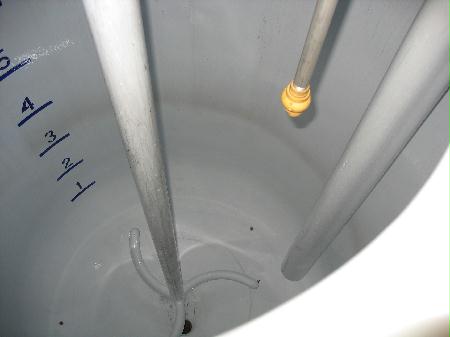
Process Wednesday: maximum stirrable volume

What is the maximum stirrable
volume of a beer stein?
Photo credit: thenibble.com
Continuing with Kilomentor's comments on reactor volume, he comments on maximum stirrable volume:
In order to minimize the number of vessels used in a step, the workup of a reaction is preferably conducted in the reactor vessel. In order to calculate the highest possible kilograms of intermediate product that can be produced in a particular reactor in a single run one needs to first determine what point in the protocol requires the largest stirred volume. Then the protocol is rescaled so that at that point this volume is equal to the maximum stirrable volume of the particular reactor. For example, suppose the protocol you are going to follow will produce 45 grams of purified product and at the point of maximum volume in this procedure the combined organic and aqueous solutions are 500 mL. if the maximum stirrable volume for the reactor you propose using in production is 2200 litres then the maximum throughput per run will be (2200/500) X 45 = 198 kg. Now if the target of your project will require you to make 450 kg of this intermediate, you will need at least three runs of this step because the maximum amount two runs can give is 396 kg. 
Now if you could modify the protocol so that at the point of maximum volume the volume were only 440 litres, you could make the 450 kg of material in just 2 runs. Providing a margin of safety against shortfalls by planning for 3 runs may be the wisest course of action.
As opposed to minimum stirrable volume, this is a concept that applies to lab-scale chemistry. Ever been working up a reaction in a 500 mL flask and found that you need to add 1 L of water to quench?

When you're planning a reaction for the first time, it's not a terrible idea to add up all the volume you're adding to a reaction and see if you're going to exceed the maximum stirrable volume of your flask -- it might save you some time.  

Tuesday, June 14, 2011

Daily Pump Trap: 6/14/11 edition

Good morning! Between June 9 and June 13, there were 22 new positions posted on the ACS Careers website. Of these, 6 (27%) are academically connected.

Rolla, MO: Brewer Science is once again looking; this time, for a A.A./B.S. chemist to be a Research Associate III in the Advanced Packaging R&D group. Looks like this position is half bench chemistry, half project management.

Polymers!: Dow Chemical is looking for a Ph.D. chemist to be an associate scientist in their polyurethanes process group. 1 year industrial experience required, as well as experience with ASPEN process simulation software.

They're back!: Halcyon Molecular is looking for an instrumentation technician to repair and maintain an absolute fleet of HPLCs and GCs. Uh, good luck with that one.

Helpful or not?: Amway is looking for a B.S./M.S./Ph.D. analytical chemist to perform method development and other analysis on cosmetics. They're advertising the salary range, (72-82), which I find interesting. Helpful or not helpful? I dunno. Southwestern Michigan, if that's your thing.

Iselin, NJ: BASF desires a Ph.D. chemist to perform heterogenous catalysis research. 1 year experience desired.

Zeroes!: Total Petrochemicals is looking for a Ph.D. chemist to work on styrene exploratory research. 0-3 years of postdoctoral work or experience in petrochemicals desired.

Lovely Baltimore: Goucher College desires a B.S. chemist to be its stockroom manager and its departmental chemical hygiene officer. Could be a great job!

One of the coolest jobs in chemistry: The Chemical Safety Board is looking for investigators!

One more for southwestern MI: Kalexsyn is looking for medicinal/organic chemists at all levels, primarily focusing on M.S./Ph.D.-level folks. Kalamazoo is home to a competitive Wiffle ball league, among other things.

Monday, June 13, 2011

Chemical engineers fare better than chemists. In other news, dog bites man.


From today's edition of Chemical and Engineering News, an article on the hiring of chemical engineers in the biotech world by Sophie Rovner:
Chemical engineering employment is “always steady, with fewer ups and downs in the job market” than chemists have to contend with, says David G. Jensen, managing director for biopharmaceutical life sciences at Kincannon & Reed, a Waynesboro, Va., executive search firm. “I’ve been doing this work for 25 years and have never seen a downtime for biotech chemical process development engineers,” adds Jensen, who writes extensively about careers and also moderates the American Association for the Advancement of Science’s online Science Careers Forum. 
Robust demand for chemical engineers may explain why wages are holding up well in the profession. In a survey of salaries for 2011 bachelor’s degree graduates, chemical engineers placed first, with an average salary offer of $66,886, according to the National Association of Colleges & ­Employers. 
The American Chemical Society’s own surveys of members consistently show that chemical engineering graduates receive higher salaries and are more likely to hold permanent full-time jobs than graduates with degrees in chemistry (C&EN, March 14, page 52).
Rovner's article is pretty interesting, with a couple of in-depth looks at what chemical engineers do on a regular basis. A small point: Rovner doesn't cover (IIRC) what I see as the broad economic sweep, which is that the smaller companies that were looking at bio-based materials during the 2007-2008 oil price spike (e.g. the Amyrises of the world) are now large enough and developed enough to be hiring chemical engineers to develop their processes to larger scale. I wonder if I'm right.

Another note: Hanson's short article (also linked above) is worth reading, if only to see that the broader economic trends are hitting chemical engineers as well.

It's apparent to me that if you're mathematically, mechanically and chemically inclined, you should think long and hard about a career in chemical engineering. I'll note (said the fox, looking at the grapes) that I have worked with chemical engineers a number of times. I've never envied what they do, but I have always envied* their salaries.

*I'm not much a salary envier, I might note; if I was, I don't think I could deal with life very well. 

Friday, June 10, 2011

What is the minimum amount of equipment needed to run a chemistry business?

In the entrepreneurship thread, the discussion turned to how to set up a small business performing chemistry:
Anon060720110900a: The idea that anyone other than tenured professors with a LOT of clout can just go off and found a science/chemistry based startup is TOTAL bunk. Of course, you can find the one or two cases in which it happened (google Halcyon Molecular). But seriously, the Zuckerberg model of "start the company from your dorm room" works great for software, but once you realize that you need fume hoods, AFMs, TEM's, compliance with federal/state/municipal hazard laws, etc, the model falls apart real quick. 
Anon060820111000a: I hear such space exists in the Silicon Valley with all the permits to do chemistry, and landlord offers proper waste disposal in the rent which is about $5000 per month. They don’t provide chemicals, glassware or Scifinder access. Better have a client list with orders or a big bankroll.
What's the smallest amount of glassware, etc that you need to set up a lab? My list would consist of:
  • A hood
  • A small set of glassware
  • A heating mantle
  • Temperature probe (or thermometer)
  • Flash column
  • TLC plates
  • Rotovap
  • Access to an HPLC and/or an NMR
  • SciFinder access (or a nearby university)
  • A laptop (combination lab notebook and lab radio)
I think that's about all I would need, but I'm going to guess that I've just listed off about $10,000 worth of equipment. 

The operating overhead for chemistry is just really high -- that hurts small business formation and I'm not sure what to do with it. Readers, what say you? What's the smallest amount of equipment you need? 

The US' newest export: assistant professors?


From the Washington Post a couple weeks back, Matthew Stremlau (a postdoc at Broad) writes about working as a (visiting) scientist in China:
The global science landscape is radically different from what it was when I started graduate school 10 years ago. Opportunities for cutting-edge science are sprouting in many other countries. China stands out. But there are plenty of others. India, Brazil and Singapore built world-class research institutes. Saudi Arabia aggressively recruits researchers for its King Abdullah University of Science and Technology. With a staggering $10 billion endowment there — larger than MIT’s — American scientists no longer need to suffer through Boston’s endless winters. Not to be outdone, Abu Dhabi opened the Masdar Institute of Science and Technology in 2009. These emerging powers have a voracious appetite for good scientists. So they’re trying to poach ours. [snip] 
Talented scientists in this country often fall through the cracks because they can’t get funding. Agencies are deluged with applications and often have to reject as many as 90 percent of the proposals they receive. Unfortunately, the situation is likely to deteriorate further as budget cuts limit the resources available for research. So I’ve started encouraging my friends to think more creatively about their careers. Go to China, I tell them. Or Singapore or Brazil or the Middle East. If the United States can’t fund its scientific talent, find a country that will.
In Beth Halford's "Too Many PhDs" article, we heard from Amir Hoveyda that perhaps US scientists should be thinking about heading overseas to make their way into the academic world. John Schwab also mentioned that perhaps even industrially-oriented young organic chemists need to be following their passions internationally.

I suspect Stremlau would agree with me that the international science boom (represented mostly by advancing economies in the Middle East and Asia) will not last forever and will produce winners and losers. New universities may not succeed in translating money into good science and the political and economic winds may shift once again. You can't buy your way into a great science culture without changing much of your political and economic system*; many countries might balk at the price in terms of relinquishing governmental control.

I think these issues (the concerns about young postdocs heading overseas) are mostly sideshows to the real question: who will receive government funding in the future and how long will they have to wait? As crazy as it sounds, I believe that the majority of the time, the current grants system probably selects the best science to fund. But there is continued dissatisfaction with the system. I hope it will probably (hopefully) culminate in a reworking to allow younger scientists to receive more funding, earlier. Otherwise, we're making a lot of youngish professors suffer -- and they'll consider going elsewhere if the suffering is less there.

In an (unusually) optimistic conclusion, the US commitment to science is long and deep and I suspect will continue on its current funding trend for many, many years.* In the end, though, I am all for other countries investing in science and trying to poach young US scientists; to paraphrase Churchill, science, science is better than war, war.

*OK, so China and Singapore are probably going to test that assertion pretty strongly. 
**In the coming years, what's going to take the bigger hit? DoD or NIH? My bet is DoD -- yours? 

Thursday, June 9, 2011

Fewer layoffs, more firing?

You didn't coordinate with Biology to
get those assays completed in time?
Photo credit: sodahead.com
I enjoy reading the blog of Tom Ricks, the Washington Post's former longtime Pentagon correspondent. (He's since moved to the Center for a New American Security as a defense analyst.)

Ricks enjoys covering the Navy's habit of routinely firing the commanding officer (CO) of its ships and other shore units. Here, Ricks notes Commander Mike Varney, who was recently relieved for mishandling sensitive documents aboard the USS Seawolf. Here's the head of the Navy's Norfolk, VA shipyard, removed for his "command environment." Here's a post for a pair of COs removed for not stopping hazing amongst the crew of the USS Ponce.

I think Ricks thinks that the Navy's tradition of not hesitating to remove the CO of a unit is a good one, in that it's better to address a leadership problem sooner rather than later. While it certainly can be harsh (and it's well-known that captains can be removed for more-or-less bad luck), the Navy allows its ship captains to have quite a bit of freedom in their leadership styles in return.*

Would a policy like this work in the pharma industry? There aren't equivalents to ship captains in pharma, but I have noted that project managers have a special leadership role. I haven't been around long enough to note whether or not project managers get summarily removed for "lack of leadership" or other "Hey, you're just not getting the job done" issues.

Readers, what say you? Should pharma managers be removed from their positions more often (as opposed to waiting for layoffs or other attrition?) Have you seen it happen?

*It should also be noted that removal from command doesn't necessarily mean that you're immediately removed from the Navy; you're probably not going to commanding any more units, though. 

Daily Pump Trap: 6/9/11 edition

Good morning! Between June 7 and June 8, there were 7 new positions posted on the ACS Careers website.

Good news?: Cubist in Boston is looking for a B.S./M.S. chemist to be a research associate with organic chemistry lab experience.

Coffee is for closers: Setaram is looking for a B.S. chemist to be a salesperson for their line of calorimetry instruments. Looks like you're going to need to travel. West Coast residents desired.

A broader look: For the search term "chemist", Monster, Careerbuilder and Indeed are showing (respectively) 303, 591 and 3629 positions. USAjobs.gov is showing 100 positions for the search term "chemist." 

Wednesday, June 8, 2011

11 ways to really irritate your summer lab mentor

Summer students, it's early June, so it means that you're probably settling into the lab you'll be in for the next two to three months or so. Here's a few ways of getting back at the person you'll be working for/with:
  1. On a regular basis, ask your mentor "Why should the government fund this research?" She'll love you for it. 
  2. If they show you their secret stash of equipment, say loudly, "Hey, how come you're not sharing this stuff with your labmates?"
  3. Dirty glassware isn't worth cleaning -- ever. 
  4. Go through the drawers around their lab bench and loudly point out any unlabeled flasks of compounds. 
  5. Ask, "Do you have a boyfriend (or girlfriend)?" If yes, ask them "When was the last time you got to spend time with them?" If no, ask them "Why not?"
  6. If your group meeting presentation isn't going well, turn to your lab mentor and say, "You didn't prepare me well enough for this!"
  7. Ask them what the departmental Chemical Hygiene Plan is. 
  8. Every Tuesday, ask them to explain every single step of an experiment and what chemical principles are involved. Make sure they look everything up in a textbook. 
  9. Remind them that you're thinking about engineering or medical school. 
  10. If they're really, really, really messy, regularly clean up everything spotlessly. They won't be able to function. 
  11. Repeat after me: "Hey, what kind of jobs can you get after you graduate?"

Process Wednesday: minimum stirrable volume

How much distance between the blades and the bottom of
the reactor? Probably doesn't matter, right?
Photo credit: phxequip.com
Reading through Kilomentor's archives, one finds a treasure trove of information for the young process chemist. This morning, the concept of 'minimum stirrable volume':
The minimum stirrable volume is exactly what the name teaches. It is the minimum volume of liquid needed in the reactor so that the turning stirrer paddles effectively stir the reactor contents. To some extent this minimum stirrable volume depends upon what is being stirred and what will happen during the initial stage of the reaction of interest. For example, a homogeneous solution in which an exothermic refluxing occurs at the beginning of the reaction may only need the moving blades to touch the liquid surface because gas evolution and thermal convection are going to move the homogeneous liquid phase around. At the other extreme, if zinc powder, tin granules or magnesium turning need to be swept up off the bottom of the reactor, the immersion of the stirrer blades probably needs to be complete and the stirring rapid. 
The reason chemists, who are more accustomed to working in the laboratory tend to forget the minimum stirring volume constraint is that two of the most common laboratory stirrer types are the magnetic stirrer and the crescent bladed overhead mechanical type. The magnetic stir bar on the bottom of the flask so that the minimum stirrable volume is very small while the crescent bladed stirrer is very often set up with its curved edge nestled up against the bottom of the round bottomed flask in which it is installed so that again the minimum stirrable volume is close to zero.
It's been a while since I used a stir bar in any of my reactions; that being said, it still influences my thinking quite a bit. It only takes one situation in which you note that your reaction volume doesn't reach the bottom of the agitator blades to remind you of this concept. It's funny how forgetting little details like 'minimum stirrable volume' can really ruin your day...

Tuesday, June 7, 2011

Chart of the week: the tyranny of the negative slope in jobs

From the Washington Post, a breakout of job losses and gains for the Great Recession, graphically represented below:

Note: BLS manufacturing statistics for the chemicals subsector does include the pharma manufacturing as well. 

Daily Pump Trap: 6/7/11 edition

Good morning! Between June 2 and June 6, there were 83 new positions posted on the ACS Careers website. Of these, 4 (5%) were academically connected.

The NMR guy/gal: The University of Nebraska-Lincoln is looking for a Ph.D. chemist to be a "director of research instrumentation."

Wanted -- good hands: Exquadrum, Inc. is looking for a B.S./M.S./Ph.D. chemist to perform research into energetic materials chemistry. Relevant experience desired, polymer chemistry experience welcomed.

DNA -> money: Ontorii is a startup that is looking to make therapeutic oligonucleotides; they're looking for a M.S./Ph.D. chemist to perform synthesis of said nucleic acids. Automated synthesizer experience desired.

Huh: Fairmount Minerals is looking for a "highly trained" organic chemist to be a process chemist. 5+ years industrial experience desired. I have no idea what an industrial sand company wants with an organic chemist.

Not using the f-word: Pacific Northwest National Laboratories (located in beautiful, isolated Richland, Washington) is looking for a communications manager for its Fundamental and Computational Sciences division.

Wow, Merck: Of the 83 positions, 63 (76%) were from Merck. Just when you thought it was safe to click "Find A Job", they're back. Are you a chemist? Do you love chemistry? Want to be an animal services technician? How about a clinical veterinarian? Or a maintenance mechanic (well, those folks actually make pretty good money, I'll bet.) 

Monday, June 6, 2011

Joe Francisco's solution to #chemjobs: entrepreneurship

Prof. Joe Francisco
Photo credit: purdue.edu
ACS immediate past president Joseph A. Francisco writes in this week's C&EN about jobs and his potential solution to chemistry unemployment problems:
During my presidential succession, I have focused on one overarching theme—to ensure that aspiring chemists and seasoned professionals in the U.S. have the skill sets, resources, and external environment to build and sustain a robust workforce in the U.S. Given the historic levels of job loss in our enterprise over the past few years, including thousands of R&D jobs for chemists, [emphasis CJ's] I felt this was one of my most important priorities. [snip]
I appointed a task force charged with providing recommendations for how the American Chemical Society can play a vital role in helping the chemical enterprise in the U.S. remain the most innovative and entrepreneurial in the world. This Task Force on Innovation was headed by Harvard University chemistry professor and entrepreneur George M. Whitesides and consisted of eminent individuals from industry, academia, and government, all with experience in entrepreneurship.[snip]
The task force noted that the nature of innovation is changing. Over the past 15 years, the process of transforming ideas into marketable innovations within the chemical enterprise has undergone dramatic change. Innovation that disrupts existing competitive markets and creates new customers has slowed.[snip]
Nevertheless, large companies want to rebuild proprietary positions in high-margin products. They may not be innovating fast enough to compete globally, however, and they now appear to be turning to others to develop innovative products. The source of that innovation could be universities and/or start-ups. The task force found no intrinsic reason why chemistry start-ups could not be commercially successful and, in fact, documented numerous such enterprises.
In light of these trends, the task force made recommendations that fall into four major categories.
  • First, it recommended that ACS develop a single organizational unit—a “technological farmers market.” ACS is already doing much to help entrepreneurs, and these activities will continue. The new unit is envisioned as a one-stop virtual portal, supporting entrepreneurs by facilitating more affordable access to resources that would foster the creation of small companies from start-ups. Relevant resources might include information about how to start a company, management expertise, links to key services, and a list of potential mentors. [snip]
  • Second, the task force recommended that ACS increase its advocacy of policies at the federal and state level to improve the business environment for entrepreneurs and start-up companies. The task force suggested that ACS urge and support reforms within the U.S. Patent & Trademark Office to ensure more accurate patents and faster issuance. Incidentally, ACS has suggested to PTO that the society’s talented unemployed members might be of assistance to patent examiners. [emphasis CJ's] The task force also outlined a number of financial policies that could encourage large companies to partner with small ones to promote entrepreneurship. These include preferential tax treatment for repatriated income invested in U.S.-based developers of technology and making the R&D tax credit simpler and permanent.
  • Third, the task force urged ACS to partner more vigorously with academic institutions and other relevant organizations to promote awareness of career pathways and educational opportunities that involve entrepreneurship. The task force had several interesting suggestions that will be pursued by staff and governance units.
  • Finally, the task force determined that ACS should increase public awareness of the value of early-stage entrepreneurship in the chemical enterprise with focused media coverage and information targeted to federal agencies that support chemistry. In addition, ACS should provide ways to recognize entrepreneurs publicly in order to increase their visibility and enhance their opportunities for success.
A couple of comments:

Entrepreneurship again? At some point in the near future, I should do a survey of all the different solutions that people have suggested to improve the chemistry employment situation. Among the top five must be this thought that chemists need to found their own companies and strike out on their own. While I think this might be a stopgap solution that might employ a small amount of very experienced chemists, and a moderate amount of mid-career professionals and young chemists, I just don't see this as a broad-based solution. I hope I'm wrong.

I hear the microwave in the kitchen!: I suspect that ACS' policy has always been to support the idea that we should support "preferential tax treatment for repatriated income invested in U.S.-based developers of technology and making the R&D tax credit simpler and permanent." While I suppose this might (in a bank-shot fashion) help chemical entrepreneurs, I suspect that the effects will be pretty minimal.

An unalloyed good: I sense from the occasional ACS comments in C&EN that the senior management of the Society is aware of the dissatisfaction of their members due to the extraordinary economic circumstances of the moment. That Prof. Francisco (or his staff) is writing about the issue and attempting address it is good news; perhaps this fall, the new ACS presidential candidates can address the issue full-force.

Best wishes to all of us. 

Friday, June 3, 2011

Unemployment number up 0.1% to 9.1%; U6 at 15.8%

Fresh electrons from BLS: the official unemployment rate for May 2011 is up 0.1% to 9.1%. The broader measurement of unemployment (U6) is down 0.1% to 15.8%.

Non-farm payroll went up by a relatively small 54,000. Can't tell if this is bad news, but it sure isn't good news. 

Green rubber stoppers

A list of small useful things (links):