Friday, February 19, 2021

Still interested in reshoring manufacturing...

Via the New York Times, this comment on White House moves around manufacturing: 
WASHINGTON — President Biden came into office with plans to help the economy recover from the coronavirus pandemic and spur a domestic manufacturing revival for goods such as automobiles and semiconductors.

But one month into his presidency, a global chip shortage has shuttered auto factories in the United States, slowed shipments of consumer electronics and called into question the security of American supply chains.

The shortage of a vital component for automobiles, phones, refrigerators and other electronic devices is posing an early challenge to the administration’s promise to revive a manufacturing sector depressed by the pandemic. And it has spurred an effort by the administration to reach out to U.S. embassies and foreign governments to try to alleviate the shortage, even as the White House acknowledges that there are most likely few solutions to the supply crunch in the short term.

The White House plans to issue an executive order soon that will take steps to address these kinds of vulnerabilities in critical supply chains over the longer term, an administration spokesperson said on Thursday. The order will begin a review of domestic manufacturing and supply chains for critical materials — including rare earths, medical supplies and semiconductors — with a particular focus on reducing dependencies on unreliable or unfriendly foreign actors.

Will be interesting to see if this ~continuation of Trump Administration reshoring efforts will have an appreciable effect on long-term chemical manufacturing employment in the US.  

Thursday, February 18, 2021

35 new positions at Organic Chemistry Jobs

Common Organic Chemistry is resolving some technical difficulties, but has ported over the list to Google Drive for now. There are 15 new positions for February 16 and 20 new positions for February 12. 

Don't forget to check out the Common Organic Chemistry company list, a very helpful resource for organic chemists looking for potential employers. 

Wednesday, February 17, 2021

Wednesday poetry: Nemesis, by Vijay Seshadri

Published in The Café Review

Your aeroplane is pulling out its stops.

Your aeroplane is growling with its props,


pawing the tarmac with its landing gear,

streaming exhaust.  That one sortie is here


that you’ve been fearfully anticipating.

12-o’clock high, the Red Baron is waiting


in a holding pattern behind the sun,

his mind as focussed as his Gatling gun,


inviting you there, up to the skies,

you, his one absent precious prize.


He wants to silence your persiflage,

to put your picture on his fuselage.


He wants his mind relieved of you.

He wants his gun to talk to you,


embracing the murderous dialogue.

He doesn’t care that you’re just a dog.

Automotive battery research in the NYT

Not every day you see gloveboxes in the New York Times
(photo of QuantumScape in Silicon Valley)
credit: Gabriela Hasbun for The New York Times
Via the New York Times, this article: 

As automakers like General Motors, Volkswagen and Ford Motor make bold promises about transitioning to an electrified, emission-free future, one thing is becoming obvious: They will need a lot of batteries.

Demand for this indispensable component already outstrips supply, prompting a global gold rush that has investors, established companies and start-ups racing to develop the technology and build the factories needed to churn out millions of electric cars.

...One thing is certain: It’s a great time to have a degree in electrochemistry. Those who understand the properties of lithium, nickel, cobalt and other materials are to batteries what software coders are to computers. Jakub Reiter, for example, has been fascinated with battery chemistry since he was a teenager in the 1990s in Prague, long before that seemed like a hot career choice.

Mr. Reiter was doing graduate research in Germany in 2011 when a headhunter recruited him to work at BMW, which wanted to understand the underlying science of batteries. Last year, InoBat poached him to help set up a factory in Slovakia, where Volkswagen, Kia, Peugeot and Jaguar Land Rover produce cars.

Mr. Reiter is now head of science at InoBat, whose technology allows customers to quickly develop batteries for different uses, like a low-cost battery for a commuter car or a high-performance version for a roadster.

“Twenty years ago, nobody cared much about batteries,” Mr. Reiter said. Now, he said, there is intense competition, and “it’s a big fight.”

Always glad to see chemists of any stripe getting their turn in the sun. It will be interesting to see if the observation that it's a great time to be an electrochemist comes true, and where the battery designers of the future will be located... (can you actually get a degree in electrochemistry?) 

Tuesday, February 16, 2021

The 2021 Faculty Jobs List: 285 research/teaching positions and 47 teaching faculty positions

The 2021 Chemistry Faculty Jobs List (curated by Andrew Spaeth and myself) has 285 research/teaching positions and 47 teaching assistant professor positions.

Want to help out? Here's a Google Form to enter positions.

In 2020-2021, we will be adding teaching professor positions, targeting positions that demonstrate an intention to renew permanently, 3 year terms and a promotion ladder and/or are titled "assistant teaching professor" or "associate teaching professor." We are adding community college positions if they explicitly offer tenure.

On February 18, 2020, the 2020 Chemistry Faculty Jobs List had 539 research/teaching positions and 65 teaching faculty positions.

To see trending, go to Andrew Spaeth's visualization of previous years' list.

Want to talk anonymously? Have an update on the status of a job search? Go to the fourth open thread. Here's the third open thread, which closed on January 20, 2021. Click here for the second thread, which closed on December 22. Click here for the first open thread, which closed on November 11, 2020.

Don't forget to click on "load more" below the comment box for the full thread. 

This will be the fifth open thread, starting at noon Eastern, Tuesday, February 16. 

The Academic Staff Jobs List: 98 positions

The Academic Staff Jobs list has 98 positions.

This list is curated by Sarah Cady and @nmr_chemist. It targets:
  • Full-time STAFF positions in a Chem/Biochem/ChemE lab/facility at an academic institution/natl lab
  • Lab Coordinator positions for research groups or undergraduate labs 
  • and for an institution in Canada or the United States
Want to help out? Here's a Google Form to enter positions.

Want to chat about staff scientist positions? Try the open thread.

Monday, February 15, 2021

Crime syndicates in Asia getting into chemical manufacturing?

From Reuters, this interesting news: 

BANGKOK (Reuters) - Crime syndicates in Asia’s drug-producing Golden Triangle region have likely begun producing ingredients to manufacture methamphetamine, enabling them to avoid restrictions on importing precursors such as pseudoephedrine and ephedrine.

The development shows a new level of sophistication by drug syndicates as “pre-precursors” such as propionyl chloride are far less tightly regulated and easier to obtain.

“It is increasingly clear organised crime are using pre-precursors and have particularly impressive capacities in place to produce their own precursors - something nobody understood until recently,” said Jeremy Douglas, the U.N. Office on Drugs and Crime (UNODC) regional representative for Southeast Asia.

But more recently production has boomed in amphetamine-type stimulants, especially methamphetamine, or meth as it is known, with the amount coming out of the Golden Triangle rising rapidly for a decade.

Authorities in Asia seizing a record 139 tonnes of meth in 2019, up from 127 tonnes in 2018 and 82.5 tonnes in 2017, UNODC data showed.

Happily, I don't know much about the supply chain for methamphetamine manufacture. It's a bit surprising to me that folks are undertaking the manufacturing of "pre-precursors" - what's more likely, that crime syndicates are starting the manufacture of chemicals like propionyl chloride on their own, or just taking the supply from an already existing plant? 

(surely you can't run a propionyl chloride manufacturing plant without being noticed?)

A tough boss

Via the New York Times, this little Jeff Bezos anecdote: 

Jeff has an uncanny ability to read a narrative and consistently arrive at insights that no one else did, even though we were all reading the same narrative. After one meeting I asked him how he was able to do that. He responded with a simple and useful tip that I have not forgotten: he assumes each sentence he reads is wrong unless he can prove otherwise.

I've met my fair share of skeptical bosses, but I'm not sure I've met one that's skeptical in detail. 

Friday, February 12, 2021

Have a good weekend!

Well, we've made it through another week. Happy Lunar New Year to those who celebrate, and hope you have a great weekend. See you on Monday. 

Small US mask manufacturers are having a tough time

Via the New York Times: 

A year into the pandemic, the disposable, virus-filtering N95 mask remains a coveted piece of protective gear. Continuing shortages have forced doctors and nurses to reuse their N95s, and ordinary Americans have scoured the internet — mostly in vain — to get them.

But Luis Arguello Jr. has plenty of N95s for sale — 30 million of them, in fact, which his family-run business, DemeTech, manufactured in its factories in Miami. He simply can’t find buyers.

After the pandemic exposed a huge need for protective equipment, and China closed its inventory to the world, DemeTech, a medical suture maker, dived into the mask business. The company invested tens of millions of dollars in new machinery and then navigated a nine-month federal approval process that allows the masks to be marketed.

But demand is so slack that Mr. Arguello is preparing to lay off some of the 1,300 workers he had hired to ramp up production. “It’s insane that we can’t get these masks to the people who desperately need them,” he said.

In one of the more confounding disconnects between the laws of supply and demand, many of the nearly two dozen small American companies that recently jumped into the business of making N95s are facing the abyss — unable to crack the market, despite vows from both former President Donald Trump and President Biden to “Buy American” and buoy domestic production of essential medical gear...

The article says what we've known for a while: American purchasing agents, CEOs and corporate boards might talk a good game about supporting domestic manufacturing, but they're driven by dollars and cents. Still waiting for that decoupling...

Thursday, February 11, 2021

29 new positions at Organic Chemistry Jobs

Common Organic Chemistry is resolving some technical difficulties, but has ported over the list to Google Drive for now. There are 27 new positions for February 8.

Don't forget to check out the Common Organic Chemistry company list, a very helpful resource for organic chemists looking for potential employers. 

NACE projects Class of 2021 BS chemistry starting salaries will drop 3%

From the inbox, the latest survey projections from the National Association of Colleges and Employers: 

The average starting salary projections for all reported categories of majors for Class of 2021 bachelor’s degree graduates show increases, albeit some of them are on the smaller side, according to NACE’s Winter 2021 Salary Survey.

...Class of 2021 graduates earning degrees in the computer sciences field are one exception to the small increases in starting salary projections. The average salary projection for these graduates is $72,173, which is a climb of 7.1% from last year’s projection of $67,411 for the Class of 2020.

It is important to note that, although all categories are projected to see increases in their salaries, not all majors within the category are expected to do so. For example, the overall average salary for math and sciences majors is expected to increase 1.3% to $63,316. However, chemistry majors, who fall into this category, are projected to see their average salary drop 3% to $59,625, while math majors are expected to average $67,360—a 4.5% increase.

I can't access the report, so I can't quite see how the sausage is made to get to this number. Would be interesting to know what the errors bars around these projection are, and how well these projections actually bear out.  

Wednesday, February 10, 2021

Hacking hits water plant in Florida

Via the New York Times, this bad news: 

Hackers remotely accessed the water treatment plant of a small Florida city last week and briefly changed the levels of lye in the drinking water, in the kind of critical infrastructure intrusion that cybersecurity experts have long warned about.

The attack in Oldsmar, a city of 15,000 people in the Tampa Bay area, was caught before it could inflict harm, Sheriff Bob Gualtieri of Pinellas County said at a news conference on Monday. He said the level of sodium hydroxide — the main ingredient in drain cleaner — was changed from 100 parts per million to 11,100 parts per million, dangerous levels that could have badly sickened residents if it had reached their homes.

“This is dangerous stuff,” Mr. Gualtieri said, urging managers of critical infrastructure systems, particularly in the Tampa area, to review and tighten their computer systems. “It’s a bad act. It’s a bad actor. It’s not just a little chlorine, or a little fluoride — you’re basically talking about lye.”

So that's bad, i.e. someone is up to no good with the internet, and intends to do Americans harm. (Imagine if they had access to the potassium permanganate supplies!) Here's my question - why are we hooking up physical infrastructure to the internet? That seems unwise... 

NYT: oxygen tank shortages in Mexico

Via the New York Times, an understandable, but sad story: 

MEXICO CITY — Children call him begging for oxygen for their parents. Grandparents call gasping for air in the middle of the night. People with no cash offer him their cars instead.

Juan Carlos Hernández tells them all the same thing: He has no oxygen tanks left.

After surviving his own bout with the coronavirus and then losing his job, Mr. Hernández began selling oxygen tanks out of his car. Then a second wave of the coronavirus slammed into Mexico this winter and demand for oxygen exploded, spawning a national shortage of devices that deliver the lifesaving resource.

...The government has sent the Mexican National Guard to protect trucks transporting oxygen tanks and required suppliers to prioritize oxygen produced for human consumption over industrial oxygen used by companies. Mexico City opened several stations where people can refill tanks free.

But Mexico doesn’t produce oxygen tanks and can’t import them from the United States right now. “It’s impossible,” Mr. Sheffield said. “The demand is very high in the States.” Orders from China will take months to arrive.

So Mexicans are left to jostle for the limited supply of oxygen tanks being passed from household to household by entrepreneurial types like Mr. Hernández.

I seem to recall an aspect of this happening in Los Angeles. The pandemic has had a way of showing the weaknesses in our supply chains. Hard to know who makes gas bottles, but I can't imagine there are a lot of suppliers. Best wishes to the people of Mexico, and to all of us. 

Tuesday, February 9, 2021

The 2021 Faculty Jobs List: 279 research/teaching positions and 44 teaching faculty positions

The 2021 Chemistry Faculty Jobs List (curated by Andrew Spaeth and myself) has 279 research/teaching positions and 44 teaching assistant professor positions.

Want to help out? Here's a Google Form to enter positions.

In 2020-2021, we will be adding teaching professor positions, targeting positions that demonstrate an intention to renew permanently, 3 year terms and a promotion ladder and/or are titled "assistant teaching professor" or "associate teaching professor." We are adding community college positions if they explicitly offer tenure.

On February 11, 2020, the 2020 Chemistry Faculty Jobs List had 537 research/teaching positions and 59 teaching faculty positions.

To see trending, go to Andrew Spaeth's visualization of previous years' list.

Want to talk anonymously? Have an update on the status of a job search? Go to the fourth open thread. Here's the third open thread, which closed on January 20, 2021. Click here for the second thread, which closed on December 22. Don't forget to click on "load more" below the comment box for the full thread. 

Chemistry Bumper Cars

Check out the latest moves here! 

To submit information, click here or e-mail chembumpercars@gmail.com

The Chemical Engineering Faculty Jobs List: 50 positions

The Chemical Engineering Faculty Jobs List has 50 positions. It is curated by Lilian Josephson (@lljosephson).

From Dr. Josephson: This year we will try to utilize the list further by circulating among the professors, as well as using the hashtags #facultychemEjobs and #MeettheCandidatesChE2020.

The open thread is found here. 

The Academic Staff Jobs List: 96 positions

 The Academic Staff Jobs list has 96 positions.

This list is curated by Sarah Cady and @nmr_chemist. It targets:
  • Full-time STAFF positions in a Chem/Biochem/ChemE lab/facility at an academic institution/natl lab
  • Lab Coordinator positions for research groups or undergraduate labs 
  • and for an institution in Canada or the United States
Want to help out? Here's a Google Form to enter positions.

Want to chat about staff scientist positions? Try the open thread.

Monday, February 8, 2021

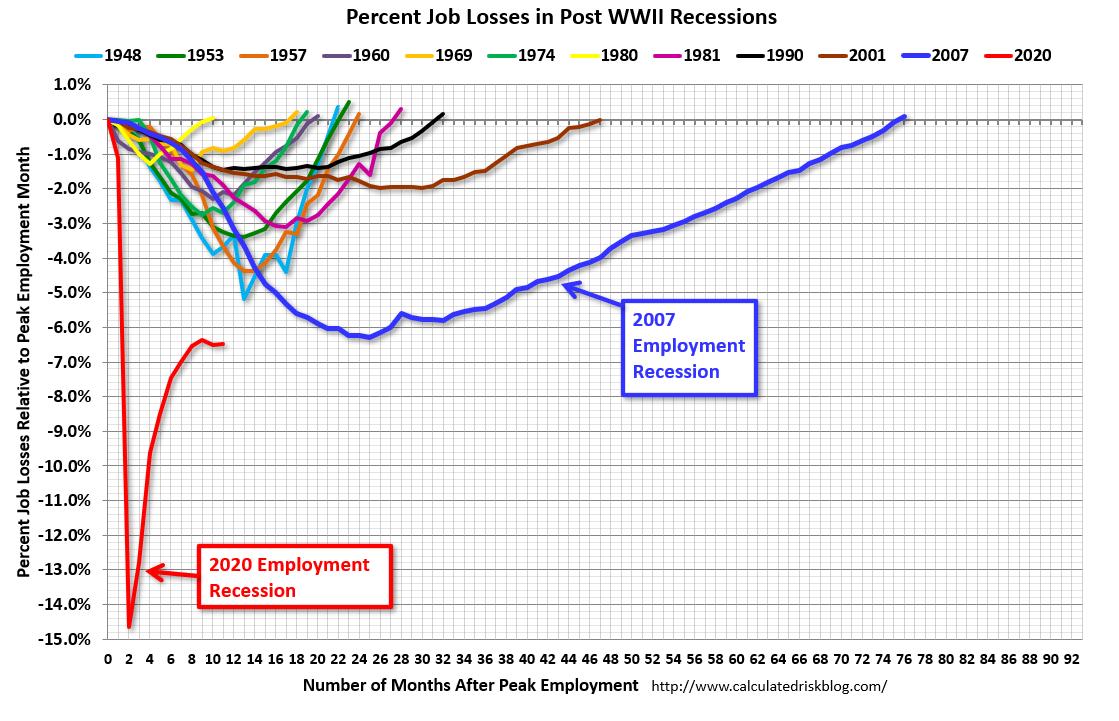
BLS: Unemployment rate for January was 6.3%; payrolls rose 49000 positions

Credit: Calculated Risk
The Bureau of Labor Statistics reported Friday that the national unemployment rate dropped to 6.3%, 
and
 payrolls rose by 49000 positions in January.

The broader U6 measurement of unemployment was 11.1%, down from 11.7% in December.

The chemical manufacturing subsector saw a rise in positions from 841100 in December to 851600 in January, a rise of 10500 positions (seasonally adjusted).

The unemployment rate of college graduates was 4.0% for January 2020, while by contrast the unemployment rate for people without a high school diploma was 9.1%.

Agilent wins IP case against Chinese firm

From this week's Chemical and Engineering News, this article from Craig Bettenhausen: 

The instrument maker Agilent Technologies has won a $1.25 million patent infringement judgment against J&X Technologies, a gas chromatography firm started in China by former Agilent employees. J&X did not defend itself in court or respond in any way.

J&X was formed by four former Agilent gas chromatography (GC) researchers in Shanghai who worked for years to develop a better way to pass samples between two different separation columns in what’s known as 2-D GC, even securing a patent for Agilent on the technology in 2012. But Agilent didn’t bring the technique to market, going instead with a competing approach. In early 2015, the researchers left and formed J&X to commercialize their work.

Later that year, the researchers approached Agilent about licensing the patent, but the company declined. So J&X went ahead and commercialized a device anyway, Agilent claims in court documents, using information in the patent and copies of lab notebooks and technical drawings the researchers had copied or taken before quitting.

 I imagine that enforcing the patent cost close to a million bucks, so I imagine this was a "principle of the thing" decision by Agilent. Will be interesting to see how this plays out...

Friday, February 5, 2021

Have a great weekend


Well, we made it to the weekend. I hope you all have a great Super Bowl weekend, and see you on Monday! 

27 new positions at Organic Chemistry Jobs

 Common Organic Chemistry is resolving some technical difficulties, but has ported over the list to Google Drive for now. There are 27 new positions for February 4.

Don't forget to check out the Common Organic Chemistry company list, a very helpful resource for organic chemists looking for potential employers. 

Novavax COVID vaccine delayed by scaling issues

In the midst of a New York Times article about the Novavax COVID vaccine, this familiar comment (emphasis mine):  

But the company struggled last fall to begin the U.S. trial by its earlier goal of October. Novavax has placed a big gamble on manufacturing, setting up plants around the world. But making these vaccines is a finicky and unpredictable process even for seasoned drug makers, and Novavax had trouble scaling up beyond the smaller batches needed for early trials.

“Things happen — small things happen,” said Stanley C. Erck, Novavax’s president and chief executive. “And so small things happen, and you lose weeks.”

Before the vaccine is authorized by the Food and Drug Administration, the company will have to show that it can consistently mass-produce the shots to the same quality as those used in its clinical trials, a high bar.

Mr. Erck said that the company is now on track to produce the 2 billion doses it has promised annually, which he acknowledged was an ambitious goal. “Some would say we’re crazy — I won’t say that, though we’re doing something that’s unprecedented,” he said.

Scale-up is hard, especially under pressure. Best wishes to the Novavax scientists, and to all of us.  


Wednesday, February 3, 2021

Wednesday art: Laboratoire Municipal de Chimie, M. Gueldry, 1887

Laboratoire Municipal de Chimie in Paris, 1887. M. Gueldry. 
Photo by Jean-loup Charmet

 Via FineArtAmerica, a painting of a French municipal chemistry lab. I like the hat on the bearded man. 

The 2020 ACS Salary Survey is out

More analysis soon, but here's a portion of the cover article from Andrea Widener: 

Like many events in 2020, the American Chemical Society salary survey was delayed by the COVID-19 pandemic. Normally conducted in the spring, the survey collected data in June and July of last year. The data shown here reflect the median annual salaries for 4,565 ACS members under age 70 who work as full-time employees in the US. (ACS publishes C&EN.)

The most notable change from the 2019 survey is the drop in unemployment rate. The salary survey shows an unemployment rate of 1.5% for ACS members, who were asked to report their status as of March 1, 2020. That’s down more than a point from the 2019 rate and is the lowest rate in the past 20 years. Unemployment in some regions dropped to below 1%.

Why the big drop? C&EN asked ACS its thoughts about the change and what might be causing it.

To start, there’s the date: March 1 was before most people would have felt the economic effects of COVID-19. “I would point to the rise in the economy and how our economy’s been doing in general prior to the pandemic,” says Eric Bruton, a chemist at Boeing and chair of the ACS Committee on Economic and Professional Affairs (CEPA), which oversees the salary survey. He points in particular to growth in several chemical-related industries during late 2019 and early 2020. “Overall, it’s a nice positive.”

Steven Meyers, who oversees the salary survey as ACS’s senior director of member programming, says the low employment rate “is emblematic of a trend that we’ve been seeing since the end of the last recession” in 2008–9, reflecting more than 10 years of economic growth.

The drop in unemployment in the ACS survey data isn’t reflected in the US unemployment rate in March for people with at least a bachelor’s degree, which was up slightly from 2.0% in March 2019 to 2.5% in March 2020, according to the US Bureau of Labor Statistics. ACS often uses this number to compare trends for ACS members with the larger economy.

That looks like good news, even with the typical caveats around the Salary Survey. More to come... 

Tuesday, February 2, 2021

The 2021 Faculty Jobs List: 270 research/teaching positions and 37 teaching faculty positions

The 2021 Chemistry Faculty Jobs List (curated by Andrew Spaeth and myself) has 270 research/teaching positions and 37 teaching assistant professor positions.

Want to help out? Here's a Google Form to enter positions.

In 2020-2021, we will be adding teaching professor positions, targeting positions that demonstrate an intention to renew permanently, 3 year terms and a promotion ladder and/or are titled "assistant teaching professor" or "associate teaching professor." We are adding community college positions if they explicitly offer tenure.

On February 4, 2020, the 2020 Chemistry Faculty Jobs List had 535 research/teaching positions and 58 teaching faculty positions.

To see trending, go to Andrew Spaeth's visualization of previous years' list.

Want to talk anonymously? Have an update on the status of a job search? Go to the fourth open thread. Here's the third open thread, which closed on January 20, 2021. Click here for the second thread, which closed on December 22. Don't forget to click on "load more" below the comment box for the full thread. 

Chemistry Bumper Cars

Check out the latest moves here! 

To submit information, click here or e-mail chembumpercars@gmail.com

The Chemical Engineering Faculty Jobs List: 50 positions

The Chemical Engineering Faculty Jobs List has 50 positions. It is curated by Lilian Josephson (@lljosephson).

From Dr. Josephson: This year we will try to utilize the list further by circulating among the professors, as well as using the hashtags #facultychemEjobs and #MeettheCandidatesChE2020.

The open thread is found here. 

The Academic Staff Jobs List: 91 positions

The Academic Staff Jobs list has 91 positions.

This list is curated by Sarah Cady and @nmr_chemist. It targets:
  • Full-time STAFF positions in a Chem/Biochem/ChemE lab/facility at an academic institution/natl lab
  • Lab Coordinator positions for research groups or undergraduate labs 
  • and for an institution in Canada or the United States
Want to help out? Here's a Google Form to enter positions.

Want to chat about staff scientist positions? Try the open thread.

Monday, February 1, 2021

C&EN: Dow reports Q4 gain

From C&EN's Alex Tullo: 

The fourth-quarter earnings report from Dow, the largest US chemical maker, is full of signs that the chemical sector is recovering from the pandemic-driven economic slowdown. Dow’s strong quarter follows similar performance from BASF and other companies that have given early glimpses into fourth-quarter 2020 earnings.

Dow posted sales of $10.7 billion for the period, up 4.9% from the pandemic-free fourth quarter of 2019. Its net income, excluding extraordinary items, for the quarter was $607 million, an increase of 5.2% from a year earlier.

“Overall, our fourth-quarter performance was a strong finish to a year where team Dow overcame significant macroeconomic and other external challenges,” Dow CEO Jim Fitterling told analysts on a Jan. 28 conference call.

Though Dow’s quarterly results suggest that the company has recovered, its full-year figures show that COVID-19 did leave a mark on its finances. Sales for 2020 were $38.2 billion, a 10.3% decline from 2019. Net income, barring one-time items, fell 53.2%, to $1.2 billion.

That's good news. Best wishes to Dow, and to us all.  

People are really good at smelling the difference between molecules

From a New York Times article on (what else?) COVID-induced anosmia, this interesting comment on smell research: 

...A much-discussed unit of measurement in smell studies is the J.N.D. — the Just Noticeable Difference, or the degree to which chemicals have to differ from one another in order for us to tell them apart. In November, a new paper in Nature advanced the quest for a map of olfactory perception by creating a model that can predict what odorants will smell like by contrasting their chemical makeup with that of other smells. 

The work relied on volunteers comparing hundreds of different odors and found them to be almost frustratingly good at it. “The failure to reach an absolute J.N.D. provides for yet additional evidence of an exquisite sense of smell in humans,” the authors said. “To rephrase this result: It is simply very hard to generate two multicomponent odorants that humans cannot discriminate.”

Good article, lots of basics about the sense of smell in general. 

Friday, January 29, 2021

Have a good weekend


Well, we made it. Here's hoping that you have a great weekend, and see you on Monday. 


Transit-friendly pharma or biotech?

From the inbox, a fascinating question: 

I am writing if you could have a survey in your blog for a list of pharma/biotech companies in the US that's accessible by public transit and/or those that offer company shuttle service. This would be very helpful to jobseekers who do not own a car or don't drive at all. I understand that most companies are in remote areas, but there might still be transit-friendly out there whether small, mid or big pharma anywhere in the US.

Of the major pharma hubs, it seems to me that Boston is the one that is most likely to fit our correspondent's desires. I wouldn't know much about Boston transit, but I know that Derek Lowe (used to?) writes his blog on his train ride into the city. 

I've driven around South San Francisco a bit, but I don't know if it's safe to bike around there, and I don't know what it would be like to take mass transit there either. Sorrento Valley in San Diego has the Coaster (it's been a number of years), but I think you could make it work, especially if you had a bike. I imagine that the other major hubs (New Jersey, RTP, Chicago, etc) are mostly car-bound. 

Readers, what do you think? 

Thursday, January 28, 2021

63 new positions at Organic Chemistry Jobs

Common Organic Chemistry is resolving some technical difficulties, but has ported over the list to Google Drive for now. There are 28 new positions for January 26 and 35 new positions for January 17. 

Don't forget to check out the Common Organic Chemistry company list, a very helpful resource for organic chemists looking for potential employers. 

Wednesday, January 27, 2021

Wednesday poem: Chemistry Anonymous, Claire Burch

CHEMISTRY ANONYMOUS

The chemistry of war is hard to know. 
Mysterious. I never saw it grow. 
I only saw its dark results one morning, 
there is a lot to learn
I am learning

The chemistry of war makes fun of others, 
it curls white tired lips and shouts dry anger
to the small chemistry of low and hunger
and the mock turtle fiction that men are brothers.

"Nothing is lost but that it shall be found, nothing is crumpled but that it shall rise." 
All false. 
Go find small comfort in the ground
or in a greater chemistry! He dies 
who does not whisper laughter and does not see, 
and has no hands to touch, no feet to walk. 

There is no mystery but that of wrong
on the long shadowed beaches 
of the young. 

Claire Burch

Chemical Activity Barometer up 1.5% in December

From the American Chemistry Council: 

WASHINGTON (January 26, 2021) – The Chemical Activity Barometer (CAB), a leading economic indicator created by the American Chemistry Council (ACC), rose 1.5% in January on a three-month moving average (3MMA) basis following a 1.3% increase in December. On a year-over-year (Y/Y) basis, the barometer rose 1.3% in January.

The unadjusted data show a 1.2% gain in January, accelerating from a 0.4% increase in December. The diffusion index climbed to 79% in January from 71% in December. The diffusion index marks the number of positive contributors relative to the total number of indicators monitored. The CAB reading for December was revised upward by 1.02 points and that for November was revised upward by 0.94 points. As always, the January data are provisional and subject to revision.

“With nine months of gains, the latest CAB reading is consistent with expansion in the U.S. economy,” said Kevin Swift, chief economist at ACC.

The CAB has four main components, each consisting of a variety of indicators: 1) production; 2) equity prices; 3) product prices; and 4) inventories and other indicators.

In January, production-related indicators were positive. Trends in construction-related resins and related performance chemistry were solid and suggest further gains in housing, a sector that has performed well during the COVID-19 recession. Reflecting strength in light vehicles and new business investment, resins and chemistry used in other durable goods were strong. Gains in plastic resins used in packaging and for consumer and institutional applications were positive. Performance chemistry for industry was strong, reflecting a strong manufacturing sector. U.S. exports were positive, while equity prices increased. Product and input prices were positive, as were inventory and other supply chain indicators.

Good news for the housing and automotive sectors. Best wishes to all of us. 

Japanese drugmaker reports major product contamination issue in December

 Via FiercePharma in December: 

A "grave" manufacturing error in Japan tainted antifungal tablets with high doses of a sleep medication, leading to the death of one woman in her 70s and side effects in hundreds more people. 

Kobayashi Kako, the drugmaker behind the mix-up, said employees may have failed to follow company procedure when removing and mixing ingredients for the two highly divergent drugs, Osaka newspaper Asahi Shimbun reported.

The woman passed away Dec. 10 at a Tokyo-area hospital after taking Kobayashi's antifungal drug Itraconazole 50 Meek, the newspaper said.

The company's own investigation revealed 5 milligrams of a sleep med—identified by The Mainichi Shimbun as rilmazafone hydrochloride hydrate—had been added to each problematic tablet of Itraconazole 50 Meek. That amount is two-and-a-half times what's typically included in a single rilmazafone pill...

...To prevent these sorts of mistakes, Kobayashi said it keeps its drug ingredients in clearly differentiated containers. Components for its athlete's foot med go in a pulp-based, drum can-shaped container a little less than 3 feet tall, while its sleep med is stored in a flat box that clearly bears the drug's name. The company also requires two employees to work as a team when drug ingredients are removed and mixed.

Thing is, it didn't always work out this way. There was a period when a single staffer performed that task, Kobayashi Kako admitted to Asahi Shimbun. It suspects the mix-up may have happened then. 

This is a reminder of how simple errors can have profound negative consequences, and seemingly clear distinctions can apparently be missed. 

Tuesday, January 26, 2021

The 2021 Faculty Jobs List: 259 research/teaching positions and 31 teaching faculty positions

The 2021 Chemistry Faculty Jobs List (curated by Andrew Spaeth and myself) has 259 research/teaching positions and 31 teaching assistant professor positions.

Want to help out? Here's a Google Form to enter positions.

In 2020-2021, we will be adding teaching professor positions, targeting positions that demonstrate an intention to renew permanently, 3 year terms and a promotion ladder and/or are titled "assistant teaching professor" or "associate teaching professor." We are adding community college positions if they explicitly offer tenure.

On January 28, 2020, the 2020 Chemistry Faculty Jobs List had 526 research/teaching positions and 56 teaching faculty positions.

To see trending, go to Andrew Spaeth's visualization of previous years' list.

Want to talk anonymously? Have an update on the status of a job search? Go to the fourth open thread. Here's the third open thread, which closed on January 20, 2021. Click here for the second thread, which closed on December 22. Don't forget to click on "load more" below the comment box for the full thread. 

Postdoctoral position: decarbonylative cross-coupling, Szostak Lab, Rutgers University, Newark, NJ

From the inbox: 

Project: Decarbonylative Cross-Coupling 

Applications  are  invited  for  a  post-doctoral  position  available  to  start  in  April  2021 or  as  soon  as  possible at the Department of Chemistry at Rutgers University, Newark, USA working on Decarbonylative  Cross-Coupling  under  the  supervision  of  Prof.  M.  Szostak. The  project involves  industrial  collaboration  and is focused on the development of decarbonylative cross-coupling methods. The post is available  for  an initial fixed-term period of 12 months with a possible extension subject to funding. 

Send your CV, together with a cover letter and contact details of at least three referees to Prof. Szostak at  michal.szostak@rutgers.edu The  successful  applicant  will  have  experience  in  catalysis  and  cross coupling.  Only  applications  from  candidates  with  prior  experience  in  organometallic  chemistry  and  catalysis  will  be  considered.  Interested  applicants  should  contact  Prof.  Szostak  at  michal.szostak@rutgers.edu for additional details. Review of applications will begin immediately.  

Full ad here. Best wishes to those interested.  

The Chemical Engineering Faculty Jobs List: 50 positions

The Chemical Engineering Faculty Jobs List has 50 positions. It is curated by Lilian Josephson (@lljosephson).

From Dr. Josephson: This year we will try to utilize the list further by circulating among the professors, as well as using the hashtags #facultychemEjobs and #MeettheCandidatesChE2020.

The open thread is found here. 

The Academic Staff Jobs List: 91 positions

The Academic Staff Jobs list has 91 positions.

This list is curated by Sarah Cady and @nmr_chemist. It targets:
  • Full-time STAFF positions in a Chem/Biochem/ChemE lab/facility at an academic institution/natl lab
  • Lab Coordinator positions for research groups or undergraduate labs 
  • and for an institution in Canada or the United States
Want to help out? Here's a Google Form to enter positions.

Want to chat about staff scientist positions? Try the open thread.

Monday, January 25, 2021

Department of Justice indicts DuPont, DuPont plant management

Via the Associated Press

HOUSTON (AP) — A chemical company and a former employee have been indicted for their roles in a 2014 poisonous gas leak that killed four workers at a Houston-area plant, federal prosecutors announced Tuesday.

Four employees at the now-closed DuPont chemical plant in LaPorte, Texas, died in the release of methyl mercaptan — a chemical used in the manufacture of insecticide and fungicide.

A federal indictment issued earlier this month and made public Tuesday accuses DuPont and Kenneth Sandel of knowingly failing to implement certain company safety procedures required by federal regulations. Sandel, 49, ran the unit at the plant where the employees who died worked and was responsible for ensuring unit workers followed applicable federal safety regulations, according to U.S. Attorney Ryan Patrick.

In a statement, Corteva, a spinoff that took over DuPont’s agriculture division, said the company “will never forget the colleagues we lost and will continue to honor their memory.”

“We strongly disagree with the basis of the U.S. Attorney’s Office for the Southern District of Texas’ decision to bring criminal charges and will contest the charges vigorously,” said Wilmington, Delaware-based Corteva.

In a statement, Amy Craig and Miles Ehrlich, Sandel’s attorneys, said their client “did not cause this accident and he did nothing wrong. Charging him with a crime compounds the tragedy of this case. Ken Sandel is absolutely innocent and we are confident a jury will agree.”

During a hearing before a federal magistrate judge Tuesday morning, the company and Sandel pleaded not guilty to the charges. Jury selection in the case was set for March 29.

According to prosecutors and the indictment, Sandel and DuPont engineers allegedly devised a plan to divert a large volume of methyl mercaptan gas into a waste gas pipe system during the day before and night of the fatal incident. However, Sandel failed to implement necessary procedures to evaluate safety aspects of that plan, according to prosecutors.

The unit where the workers died did not having adequate ventilation or air monitoring to ensure employee safety, and procedures weren’t followed that would have restricted worker access into areas where ventilation fans weren’t working, according to an investigation by the U.S. Chemical Safety Board.

I covered this incident on the blog. It's hard to believe it's been 6 years. 

I'll have to understand the government's case before I comment on it much further, i.e. why the diversion plan was unsafe, and why they're holding DuPont and plant management criminally responsible for the safety aspects. Definitely a good reminder that plant safety has real consequences, both immediate and long-term. 

Friday, January 22, 2021

Have a good weekend


Well, we made it to the weekend yet again. I hope it's not too rainy or snowy where you are. See you on Monday! 

How do you make a COVID vaccine?

For those like me who are fascinated by the supply chain of the mRNA COVID vaccines, this article by Jonas Neubert is quite good: 

Welcome to the bottleneck of mRNA vaccine production! The number of people in the world who know how to get lipids and mRNA to combine into a lipid nanoparticle (LNP) might be in the low hundreds. And the machines to do it might not be machines at all but one-off lab bench setups like the one in this Wall Street Journal article. 

The problem at hand is this: How do you get the four lipids and the mRNA to combine in such a way that they form the protective sphere of the LNP, in a reproducible way? You can’t just combine all parts in your Vitamix and run the smoothie program. Well, you could, but it’s not going to give you a weird smoothie and not mRNA filled lipid nano-particles. What is of the essence is precise control of molecule sizes, precise control of flow rates, and probably precise control of many other parameters. Microfluidics is the technology of choice for these requirements and are most likely used for nanoparticle formation in mRNA vaccine making.

The author is not a scientist, so there are small errors in language, etc. But it's quite good, and collects a lot of information in a single place. Worth a read.

Wednesday, January 20, 2021

"Sunset over the Rhone", Adam Cook, 2020

Credit: "Sunset over the Rhone", Adam Cook, 2020, Cologne, Germany


Biography: Adam is a third year PhD student at the University of Ottawa, investigating nickel-catalyzed C-O activation in the lab of Prof. Stephen Newman. In his spare time (because that's totally a thing in grad school), he seeks to bridge the gap between chemistry and creativity through painting. For more on his contributions to both art and science, pay a visit to his website at www.thechempire.com

Would you like your work to be featured? E-mail Chemjobber at chemjobber@gmail.com

Smell tests for COVID?

Via the New York Times: 

...some scientists think that a quick test consisting of little more than a stinky strip of paper might at least get us close. The test does not look for the virus itself, nor can it diagnose disease. Rather, it screens for one of Covid-19’s trademark signs: the loss of the sense of smell. 

...Daniel Larremore, an epidemiologist at the University of Colorado, Boulder, and the study’s lead author, stressed that his team’s work was still purely theoretical. Although some smell tests are already in use in clinical and research settings, the products tend to be expensive and laborious to use and are not widely available. 

And in the context of the pandemic, there is not yet real-world data to support the effectiveness of smell tests as a frequent screen for the coronavirus. Given the many testing woes that have stymied pandemic control efforts so far, some experts have been doubtful that smell tests could be distributed widely enough, or made sufficiently cheat-proof, to reduce the spread of infection.

I think I'd rather do a smell test than a temperature screening, but it depends on the smell! (It would be interesting to know how many of the people who are described as 'asymptomatic' have mild anosmia.)

Tuesday, January 19, 2021

The 2021 Faculty Jobs List: 252 research/teaching positions and 31 teaching faculty positions

The 2021 Chemistry Faculty Jobs List (curated by Andrew Spaeth and myself) has 252 research/teaching positions and 31 teaching assistant professor positions.

Want to help out? Here's a Google Form to enter positions.

In 2020-2021, we will be adding teaching professor positions, targeting positions that demonstrate an intention to renew permanently, 3 year terms and a promotion ladder and/or are titled "assistant teaching professor" or "associate teaching professor." We are adding community college positions if they explicitly offer tenure.

On January 21, 2020, the 2020 Chemistry Faculty Jobs List had 521 research/teaching positions and 54 teaching faculty positions.

To see trending, go to Andrew Spaeth's visualization of previous years' list.

Want to talk anonymously? Have an update on the status of a job search? This will be the fourth open thread at noon Eastern on Tuesday, January 19. Go to the third open thread. Click here for the second thread, which closed on December 22. Don't forget to click on "load more" below the comment box for the full thread. 

The Chemical Engineering Faculty Jobs List: 50 positions

The Chemical Engineering Faculty Jobs List has 50 positions. It is curated by Lilian Josephson (@lljosephson).

From Dr. Josephson: This year we will try to utilize the list further by circulating among the professors, as well as using the hashtags #facultychemEjobs and #MeettheCandidatesChE2020.

The open thread is found here. 

The Academic Staff Jobs List: 91 positions

The Academic Staff Jobs list has 91 positions.

This list is curated by Sarah Cady and @nmr_chemist. It targets:
  • Full-time STAFF positions in a Chem/Biochem/ChemE lab/facility at an academic institution/natl lab
  • Lab Coordinator positions for research groups or undergraduate labs 
  • and for an institution in Canada or the United States
Want to help out? Here's a Google Form to enter positions.

Want to chat about staff scientist positions? Try the open thread.

Monday, January 18, 2021

US government charges MIT engineering professor

Via WBUR, this news about an MIT professor:

An MIT professor was arrested Thursday morning on federal charges that he failed to disclose ties to the Chinese government as he sought — and was awarded — research grants from the U.S. government.

U.S. Attorney Andrew Lelling said its charges against Gang Chen — paired with similar charges filed last summer against Harvard chemistry professor Charles Lieber — represent his office's attempt to counter the Chinese government's effort to "siphon off U.S. technology instead of doing the work themselves."

The charges focus on Chen's behavior since 2012, while he was running a laboratory focused on nanotechnology and energy transfer.

Chen served as chair of M.I.T.'s department of mechanical engineering from 2013 to 2018. Meanwhile, his laboratory attracted over $19 million in grants from federal agencies like the Department of Defense and the Department of Energy, according to the complaint.

Here's the full charging document; here's the press release. 

Pretty clear that the United States government is looking very carefully at business and financial ties of STEM professionals who work in both the US and China. It will be interesting to see if this continues to be a major thrust in the Biden Administration.* 

*A brief bit of political punditry: it's hard for me to imagine that the policy of a Clinton Justice Department would have been any different than that of the Trump Administration when it comes to this case, or that of Professor Lieber. 

ICIS: German chemical plants don't want to shut down for COVID lockdown

From ICIS: 

LONDON (ICIS)--Germany’s top chemical industry trade groups are rejecting calls to shut down plants as part of the country’s “hard lockdown” to contain the second wave of the coronavirus pandemic.

“A shutdown would be counter-productive, in all respects”, chemical producers group VCI and employers group BAVC said in a joint statement on Friday.

The chemical-pharmaceutical industry makes “key contributions” to containing the pandemic, the trade groups said,  in vaccine production, the manufacture of essential medicines or as the most important upstream supplier for diagnostics, medical, and laboratory equipment manufacturers.

As such, a shutdown would “considerably weaken” the fight against the coronavirus.

Furthermore, the closure of companies or plants could not be justified on an economic or commercial basis.

“Without chemical supplies, the entire industry and thus almost 30% of our economy would stand still”, they said.

Some German politicians have called for companies to increase “working from home”, and they urged to consider the closure of industrial plants in order to contain the virus.

I genuinely have a difficult time seeing a chemical plant (any chemical plant) as being a major speader of COVID, but I suspect that spread amongst operators and other employees happens in changing rooms and the like. 

Friday, January 15, 2021

Have a great weekend


Well, we made it to the weekend. I hope that your week was relatively stress-free and that you have a great Saturday and Sunday. See you on Monday. 

Tech leaving the Bay Area

Via the New York Times, a pretty interesting article about tech entrepreneurs leaving the Bay Area for elsewhere, with numbers to show for it: 

...The biggest tech companies aren’t going anywhere, and tech stocks are still soaring. Apple’s flying-saucer-shaped campus is not going to zoom away. Google is still absorbing ever more office space in San Jose and San Francisco. New founders are still coming to town.

But the migration from the Bay Area appears real. Residential rents in San Francisco are down 27 percent from a year ago, and the office vacancy rate has spiked to 16.7 percent, a number not seen in a decade.

Though prices had dropped only slightly, Zillow reported more homes for sale in San Francisco than a year ago. For more than a month last year, 90 percent of the searches involving San Francisco on moveBuddha were for people moving out.

Twitter, Yelp, Airbnb and Dropbox have tried to sublease some of their San Francisco office space. Pinterest, which has one of the most iconic offices in town, paid $90 million to break a lease for a site where it planned to expand. And companies like Twitter and Facebook have announced “work from home forever” plans...

I have long asserted that the Bay Area's dominance in the American life sciences space will continue unchecked, and it would take an epic natural disaster to change that. While I don't think the pandemic measures up, it certainly is doing its part to push people elsewhere. I still think that San Francisco will maintain its pre-eminence (1A to Boston's #1, IMO), but we shall see. 

It would be interesting to know who exactly is leaving, i.e. the people who were successful in tech entrepreneurship, or those who were not? 

Thursday, January 14, 2021

Want to see some recent starting salaries?

From a recently hired entry-level PhD organic chemist (let's call them HQN), this helpful information: 

Small/med pharma - med chem, SF: was quoted at 110-120k typical base pay, plus relocation (amount unknown)

Small pharma Boston, med chem and process: 90-100k (medium confidence on this one, this is thru the grapevine for previous hires within past few years, but nothing current right now)

Large pharma companies, med chem or process positions, Boston, Philly, Bay Area, Chicago: 115-120k base for very competitive applicants. Offers also typically included some type of sign-on bonus (10k+), as well as relo. I know a few people that fell into this category, and they were really lucky because they had multiple offers in hand and let companies actively ‘bid’ against one another.

Before receiving offers, these individuals were quoted at “97-115k” for typical base salaries.

CMO, [redacted], process: (90k?)-100k base, plus very generous relocation. (100k base was my offer, but i got stuck in the “whoever goes first, loses” camp. I did get to name my price and they met it. Glassdoor said that the range was more like 80-90k, so I thought my ask was decent. Probably could have gotten more but alas… idk how much more I could have actually gotten anyway, and without another offer immediately in hand, I kinda felt I didn't have good leverage to ask for more now. I am assuming that 90k is actual low end of the range here, but not confident on that. 

Small pharma NJ, med chem: ~92k base, 5k signing bonus in lieu of relocation.

For context, I would suggest that those who are entertaining offers really consider relocation vs signing bonus (ideally, one could negotaite for both, but if foregoing relo, think VERY hard about the actual relocation costs associated). I've heard general murmurings that sometimes companies will forego relocation packages (something to do with setting a precedent for them? idk), in lieu of a sign on bonus. I had originally thought that the NJ offer was decent, but i turned it down just because it wasnt the right company for me. In hindsight, my current relo is lavish, and the 'signing bonus' from other company would have basically ONLY covered my lease break and nothing else. 

CMO, Boston suburbs, salary range quoted was around ~80-85k iirc. I had originally asked HR for 100-110, and they said that salary would be for someone 1-2 levels above entry level PhD - their rationale was “we’re in the suburbs so CoL is different” but that still struck me as low for the greater Boston metro area.

Thanks to HQN for their kind contribution! Readers, would you like to contribute? You can add in the comments, or e-mail me at chemjobber@gmail.com 

24 new positions at Organic Chemistry Jobs

Common Organic Chemistry is resolving some technical difficulties, but has ported over the list to Google Drive for now. There are 24 new positions for January 13.

Don't forget to check out the Common Organic Chemistry company list, a very helpful resource for organic chemists looking for potential employers.

Wednesday, January 13, 2021

Wednesday art: Vincent van Gogh, Factories at Clichy, 1887

Credit: St. Louis Art Museum


C&EN: DuPont to sell Chestnut Run laboratories

In this week's C&EN, this news from Craig Bettenhausen: 
DuPont has signed a letter of intent to sell its 74,000 m2 Chestnut Run lab campus in Wilmington, Delaware, to MRA Group, a science-focused real estate development firm. The companies did not disclose financial details.

DuPont will lease several lab buildings at the site from MRA, which plans to convert Chestnut Run into a tech hub emphasizing chemistry, life sciences, and advanced materials. DuPont will retain its adjacent office space, home of the firm’s corporate headquarters since it moved from downtown Wilmington in 2014...

...A former DuPont site in Wilmington is being redeveloped as Barley Mill Plaza, a 56,000 m2 mixed-use facility. DuPont says extensive restructuring in recent years has left it with empty labs and offices in Wilmington. The firm employed around 3,000 people in Delaware in 2020, down from 7,000 in late 2015, according to IndustryWeek.
It would be interesting to know how many of these research site conversions end up generating more and better jobs than the original site, in terms of the number of positions and the quality of the wages. I'm skeptical, but it would be great to see the numbers. 

Tuesday, January 12, 2021

The 2021 Faculty Jobs List: 248 research/teaching positions and 29 teaching faculty positions

 The 2021 Chemistry Faculty Jobs List (curated by Andrew Spaeth and myself) has 248 research/teaching positions and 29 teaching assistant professor positions.

Want to help out? Here's a Google Form to enter positions.

In 2020-2021, we will be adding teaching professor positions, targeting positions that demonstrate an intention to renew permanently, 3 year terms and a promotion ladder and/or are titled "assistant teaching professor" or "associate teaching professor." We are adding community college positions if they explicitly offer tenure.

On January 14, 2020, the 2020 Chemistry Faculty Jobs List had 516 research/teaching positions and 51 teaching faculty positions.

To see trending, go to Andrew Spaeth's visualization of previous years' list.

Want to talk anonymously? Have an update on the status of a job search? Go to the third open thread. Click here for the second thread, which closed on December 22. Don't forget to click on "load more" below the comment box for the full thread. 

Postdoctoral position: organic synthesis, Trant Lab, University of Windsor, Windsor, ON

From the inbox: 

The Trant Lab at the University of Windsor is looking for a motivated postdoctoral fellow; the position is initially for 1-year and renewable indefinitely based on satisfactory  performance at $40,000/year. The candidate should have significant experience (from their  doctoral work, industrial career, or previous postdoctoral work) in multi-step small molecule  synthesis, medicinal chemistry, or process chemistry. Individuals from under-represented groups  are especially encouraged to apply. 

This includes ethnic, religious, sexual, disability, and gender  minorities as well as first-generation university students (those whose parents do not hold  university degrees). Individuals who have faced obstacles that have hindered their education and  productivity are encouraged to apply. We are looking for a good colleague with strong problem  solving and outstanding teamwork skills: a flashy CV full of top-journal publications is not  necessary, please do not self-select out. The position is expected to start as soon as filled.  

Full ad here. Best wishes to those interested:  

The Chemical Engineering Faculty Jobs List: 51 positions

The Chemical Engineering Faculty Jobs List has 51 positions. It is curated by Lilian Josephson (@lljosephson).

From Dr. Josephson: This year we will try to utilize the list further by circulating among the professors, as well as using the hashtags #facultychemEjobs and #MeettheCandidatesChE2020.

The open thread is found here. 

The Academic Staff Jobs List: 91 positions

 The Academic Staff Jobs list has 91 positions.

This list is curated by Sarah Cady and @nmr_chemist. It targets:
  • Full-time STAFF positions in a Chem/Biochem/ChemE lab/facility at an academic institution/natl lab
  • Lab Coordinator positions for research groups or undergraduate labs 
  • and for an institution in Canada or the United States
Want to help out? Here's a Google Form to enter positions.

Want to chat about staff scientist positions? Try the open thread.

Monday, January 11, 2021

BLS: Unemployment rate for November was 6.7%; payrolls fell 140000 positions

Credit: Calculated Risk
The Bureau of Labor Statistics reported Friday that the national unemployment rate stayed at 6.7%, and
payrolls fell by 140000 positions in December.

The broader U6 measurement of unemployment was 11.7%, down from 12.1% in November.

The chemical manufacturing subsector saw a rise in positions from 835200 in November to 835800 in December, a rise of 600 positions (seasonally adjusted).

The unemployment rate of college graduates was 3.8% for December 2020, while by contrast the unemployment rate for people without a high school diploma was 9.8%.


Weird COVID-19 phantom smells (?)

I'm not someone possessed of a keen sense of smell, but I'm pleased to have it as a very crude means of determining whether or not I have caught COVID-19 (I have not yet, so far as I know.) The experience of those with COVID-19 related anosmia has been well-documented, but this New York Times article was fascinating: 
...Smell alerts the brain to the mundane, like dirty clothes, and the risky, like spoiled food. Without this form of detection, “people get anxious about things,” Dr. Dalton said.

Even worse, some Covid-19 survivors are tormented by phantom odors that are unpleasant and often noxious, like the smells of burning plastic, ammonia or feces, a distortion called parosmia.

Eric Reynolds, a 51-year-old probation officer in Santa Maria, Calif., lost his sense of smell when he contracted Covid-19 in April. Now, he said, he often perceives foul odors that he knows don’t exist. Diet drinks taste like dirt; soap and laundry detergent smell like stagnant water or ammonia.

“I can’t do dishes, it makes me gag,” Mr. Reynolds said. He’s also haunted by phantom smells of corn chips and a scent he calls “old lady perfume smell.”

Weird/fascinating how smell is related to our nervous system, and how the virus has altered it for some. I imagine we'll eventually get a handle on this, but it won't come soon enough... 

I wonder what the corn chips thing is about - olfactory nerve phantom pain? 

Friday, January 8, 2021

Have a good weekend


Well, we made it through another week. It's been a long one. I hope you have a good weekend. See you on Monday. 

NYT: Pandemic reverses skilled emigration for Italy

Via the New York Times: 

When Elena Parisi, an engineer, left Italy at age 22 to pursue a career in London five years ago, she joined the vast ranks of talented Italians escaping a sluggish job market and lack of opportunities at home to find work abroad.

But in the past year, as the coronavirus pandemic forced employees around the world to work from home, Ms. Parisi, like many of her compatriots, seized on the opportunity to really go home, to Italy.

In between Zoom meetings and her other work for a recycling company in London, she took long strolls on the beach near her family’s home in Palermo, Sicily, and talked recipes at dawn with vendors in the local market.

“The quality of life is a thousand, thousand times better here,” said Ms. Parisi, who is now in Rome.

I imagine that there are some chemists who may have been able to return home (wherever that may be) due to the pandemic, but how long will that last?  

Wednesday, January 6, 2021

Wednesday poem: There Will Come Soft Rains, Sara Teasdale (1884-1933)

There will come soft rains and the smell of the ground,

And swallows circling with their shimmering sound;


And frogs in the pools singing at night,

And wild plum trees in tremulous white,


Robins will wear their feathery fire

Whistling their whims on a low fence-wire;


And not one will know of the war, not one

Will care at last when it is done.


Not one would mind, neither bird nor tree

If mankind perished utterly;


And Spring herself, when she woke at dawn,

Would scarcely know that we were gone.


From The Language of Spring, edited by Robert Atwan, published by Beacon Press, 2003.

Random questions during interviews

From along-time denizen of chemistry Twitter Anthony Maiorana comes a new newsletter, the Polymerist. This is a long and interesting post about good approaches to job hunting, and I agree with all of it. I found these questions pretty amusing: 

In every technical presentation I’ve given I have had to answer questions from the audience. In crafting your presentation you should know many of the logical questions. If you are really good you can lead the audience with what questions you want them to ask and have the answer on the next slide.

Sometimes you get asked ridiculous questions that have no bearing on what you are presenting about. This might happen during the presentation or it might happen during 1-on-1 interviews with team members or non-team members. An example might be:

  • What is the density of water in lbs/gallons?
  • You talked about viscosity on your last slide. Explain to me what viscosity is from a fundamental point of view.
  • Can you give me the total synthesis of methyl methacrylate from crude oil?
I actually quite enjoy a good question from the audience, and I have had my job prospects sunk by a particularly good one (and one that I should have known!) The density of water question is kinda trivial-ish, but it's a good opportunity to answer trivia/think on one's feet/demonstrate the ability to calculate out loud (i.e. I know that it's 8 lbs per gallon, but you should be able to get there any number of different ways.) I also think it's fair to ask professor-ish questions about viscosity, but someone who asks about viscosity with the word "fundamental" is asking for math that I can't really do well (how do you calculate centipoise again?) 

Asking good questions in seminars is an art, and so is answering the questions, i.e. you need to stop, listen to the question, and engage the questioner as best as you can with your knowledge. It's not an easy skill to learn, and the only way to get better at it is to present one's work to an engaged audience (which is a non-trivial task itself...)

Tuesday, January 5, 2021

The 2021 Faculty Jobs List: 242 research/teaching positions and 27 teaching faculty positions

The 2021 Chemistry Faculty Jobs List (curated by Andrew Spaeth and myself) has 242 research/teaching positions and 27 teaching assistant professor positions.

Want to help out? Here's a Google Form to enter positions.

In 2020-2021, we will be adding teaching professor positions, targeting positions that demonstrate an intention to renew permanently, 3 year terms and a promotion ladder and/or are titled "assistant teaching professor" or "associate teaching professor." We are adding community college positions if they explicitly offer tenure.

On January 7, 2020, the 2020 Chemistry Faculty Jobs List had 508 research/teaching positions and 49 teaching faculty positions.

To see trending, go to Andrew Spaeth's visualization of previous years' list.

Want to talk anonymously? Have an update on the status of a job search? Go to the third open thread. Click here for the second thread, which closed on December 22. Don't forget to click on "load more" below the comment box for the full thread. 

Postdoctoral position: medicinal chemistry, York University, Toronto, ON

From the inbox: 

We have two PDF positions in medicinal chemistry, immediate start 

The successful candidate will support an ongoing medicinal chemistry program by synthesizing small drug-like molecules in a hit-to-lead optimization campaign. 

Interested candidates will have a Ph.D. in synthetic organic chemistry and a demonstrated record of problem-solving skills in the context of small molecule synthesis.

Responsibilities and skills:

  • Synthesis, purification and characterization of drug like compounds
  • Critical review of the chemical literature to solve synthetic challenges
  • Preparation of weekly progress reports to support publications and patents
  • Supervision and mentorship of undergraduate and graduate students

We offer a competitive post-doctoral salary and benefits. 

Interested applicants should contact professor Orellana by e-mail with a CV, detailed research summary and references.

Best wishes to those interested.  

Job posting: visiting assistant professorship, organic chemistry, Soka University of America, Aliso Viejo, CA

From the inbox: 

The Life Sciences concentration at Soka University of America (SUA) seeks to fill a full-time visiting assistant professorship in Organic Chemistry, beginning on August 16, 2021.This is a one-year position. The successful candidate will demonstrate the ability to engage students in small classroom and laboratory settings. This position will support SUA’s new Concentration in Life Sciences housed in a new state-of the-art science teaching and research facility. 
The teaching responsibilities of this position include developing and teaching Organic Chemistry courses (I and II) and general education courses for non-science students. All courses should involve students via project-based and active learning approaches suitable for small class sizes. The teaching load per academic year is five courses. This individual will also be responsible for operating, maintaining, and training users on our new nuclear magnetic resonance (NMR) spectrometer. We anticipate hiring a tenure-track Organic Chemistry professor in the next few years.

Full ad here. Best wishes to those interested.  

The Chemical Engineering Faculty Jobs List: 48 positions

The Chemical Engineering Faculty Jobs List has 48 positions. It is curated by Lilian Josephson (@lljosephson).

From Dr. Josephson: This year we will try to utilize the list further by circulating among the professors, as well as using the hashtags #facultychemEjobs and #MeettheCandidatesChE2020.

The open thread is found here. 

The Academic Staff Jobs List: 88 positions

The Academic Staff Jobs list has 88 positions.

This list is curated by Sarah Cady and @nmr_chemist. It targets:
  • Full-time STAFF positions in a Chem/Biochem/ChemE lab/facility at an academic institution/natl lab
  • Lab Coordinator positions for research groups or undergraduate labs 
  • and for an institution in Canada or the United States
Want to help out? Here's a Google Form to enter positions.

Want to chat about staff scientist positions? Try the open thread.

Monday, January 4, 2021

Bad times in petroleum engineering

Via the New York Times, this article: 
Sabrina Burns, a senior at the University of Texas at Austin, had thought she would be launching a lucrative career in the oil and gas industry when she graduated in a few months. But the collapse in the demand for oil and gas during the coronavirus pandemic has disrupted her well-laid plans and is forcing her to consider a new path.

“We got a slap in the face, an entirely unforeseen situation that rocked our entire mind-set,” said Ms. Burns, who is studying petroleum engineering. “I have applied for every oil and gas position I’ve seen, like all my classmates, and nothing really has turned up. I’m discouraged.”

With fewer people commuting and traveling, the oil and gas industry has taken a punishing blow. Oil companies have laid off more than 100,000 workers. Many businesses have closed refineries, and some have sought bankruptcy protection...

...Ms. Burns, 22, said her choices have narrowed considerably over the last nine months. With opportunities in oil and gas limited, she recently accepted an internship with an engineering consulting firm specializing in energy conservation, and she may eventually apply to graduate school in environmental science. She is also considering moving in with her sister after graduation to save money.

“I feel like companies are going to be pretty cautious about coming out of this, about taking new hires,” she said.

Ms. Burns was enticed into an oil and gas career by stories her father, a helicopter pilot, told her about the successful female engineers he had met servicing offshore rigs in the Gulf of Mexico. But while her professors have talked up the future for oil and gas companies, she is worried.

This must be a near-historically-bad time to be an entry-level petroleum worker, i.e. there's the problem of the pandemic, and there are also cross-pressures in the broader energy industry. I'm a bit surprised that her professors didn't seem to warn her about the up-and-down nature of oil and gas, but perhaps they sent missed signals. 

I presume that the same issues that have hit Ms. Burns have also hit the various chemists who work in and around the oil and gas industry. Best wishes to them, and to all of us.